
Case Number: 25MST013
Manager: Robert Prosak
Licensing Associate, Business Development
S&T Technology Transfer & Economic Development
robert.prosak@mst.edu
PDF Download: Safer Method to Manufacture TNT-Coated High Explosive Particles Marketing Slick
Journal Publication Download: Safer Method to Manufacture TNT-Coated High Explosive Particles Publication
Opportunity
Seeking a licensing and development partner to scale into manufacturing.
Problem Statement
Trinitrotoluene (TNT) is often mixed with High Explosives (HEs) to desensitize and solidify them. TNT-coated HEs have traditionally been manufactured by either melt pour casting or melt cast and pressed. Both methods have significant drawbacks. Melt pour casting often yields inconsistent charges due to variations in TNT density and crystallinity influenced by cooling rate. Similarly, melt cast and pressed lack the necessary control over the particle size density needed within a pressed charge. There is a need for a method to make safe, affordable, and consistent HE:TNT charges.
Solution
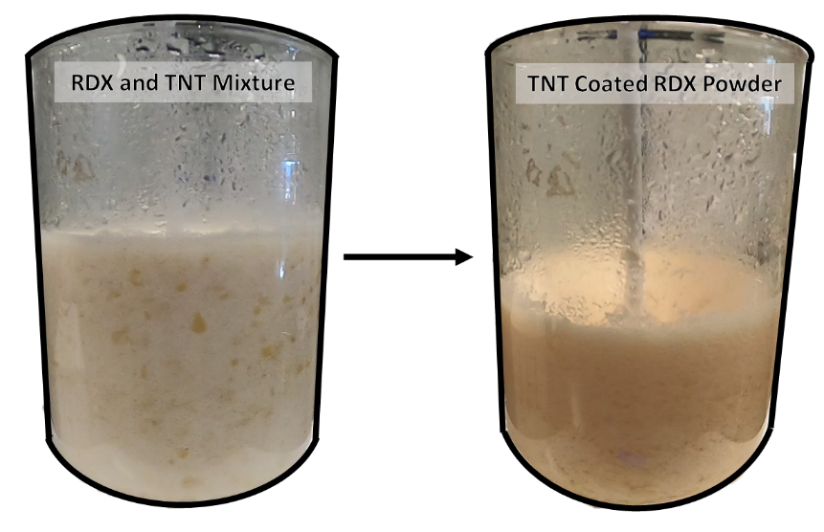
Researchers at Missouri University of Science and Technology have developed a novel method for producing TNT-coated HE powder using trinitroperhydrotriazine (RDX) as the HE. Utilizing powdered HE dispersed in boiling water allows the TNT to slowly melt in solution for uniform coating. Under microscopy, the new powder consisted of individually coated HE particles. Sensitivity testing showed that the new powder was less sensitive to friction than both powdered HE and crushed TNT. Compared to melt cast charges, the pressed TNT-coated HE powder demonstrated the most consistent density and performance and had the highest relative effectiveness.
Value Proposition
The new method for making consistent and pressable TNT/HE charges is a step forward in manufacturing economical, scalable, and safer HE:TNT charges. The new coated powder charge was found to have the highest relative effectiveness of all charges, with higher detonation pressure and a faster reaction rate.
Development Stage
Validated in the lab.
Patent Status
Provisional Patent Application Filed
Publication
https://doi.org/10.1080/07370652.2025.2472655
Investors
Catherine Johnson, PhD. and Emily Johnson, PhD.
Follow Technology Transfer and Economic Development