
Case Number: 27MST004
Manager: Robert Prosak
Director, IP & Licensing
S&T Technology Transfer & Economic Development
robert.prosak@mst.edu
PDF Download: Adaptive Exchange-Based Multi- Quota Resource Reassignment in Shared Cyber-Physical Systems PDF
Publication: Adaptive Exchange-Based Multi- Quota Resource Reassignment in Shared Cyber-Physical Systems Publication
Opportunity
Seeking a licensing and development partner to bring this technology into real EV charging and other shared resource systems.
Problem Statement
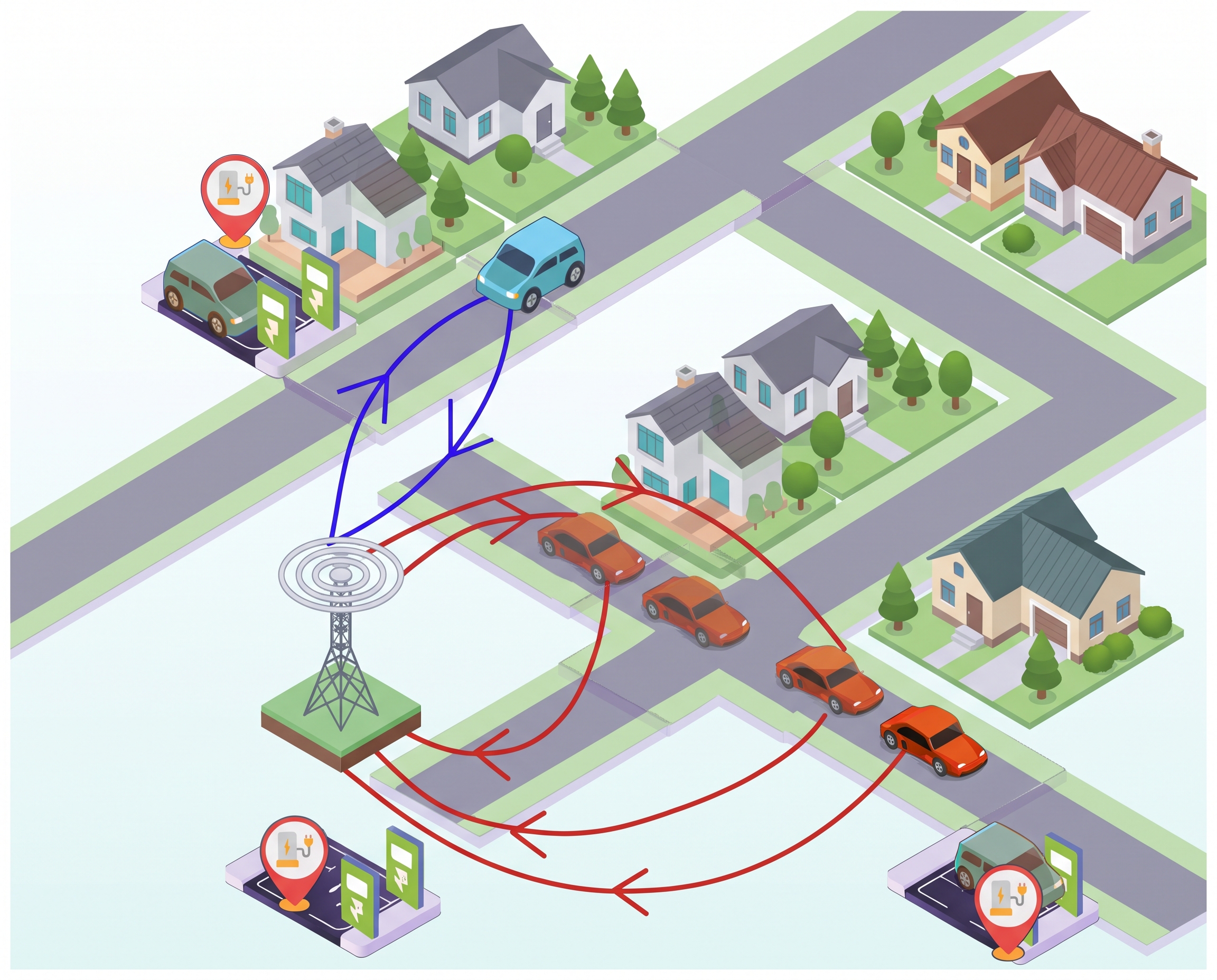
Cyber-physical systems (CPS) assign shared resources such as EV chargers and parking spots to users. Users may deviate from recommended assignments. Studies report that 25 to 50% of EV drivers divert from recommended chargers because of price or queues. These deviations reduce system efficiency. Recomputing the whole allocation is costly and disrupts users who followed it. Top Trading Cycles is an exchange method that lets users trade assignments based on preferences. However, classical TTC assumes one owner and one user per resource with strict rankings, while shared CPS resources may have multiple users, spare capacity, or several equally acceptable options. Therefore, shared CPS platforms need a fast reassignment method that repairs deviations without recomputing the entire allocation or disrupting users who already accepted their assignments.
Solution
Researchers at Missouri University of Science and Technology developed an adaptive exchange framework to reassign shared CPS resources after users deviate from their recommended assignments. The framework can run on top of any initial allocation method and activates only when reassignment is needed. The framework captures spare capacity, multiple users per resource, and preference-based reassignment opportunities. New graph-construction and cycle-resolution methods find direct swaps, cyclic swaps, and chain swaps. These methods show how the framework adapts to how much users and providers know about each resource. When swaps compete, it ranks them by benefit to users or to the provider. The framework is designed so that reassigned users are not worse off than their original assignment.
Value Proposition
The framework repairs assignments efficiently without recomputing the entire system, while keeping users who already accepted their assignments undisturbed. Users who followed their assignment stay untouched. It handles spare capacity and equally good options that classical TTC cannot. In EV charging simulations, the first version improved user satisfaction by at least 43% compared with existing
methods. Later extensions improved reassignment quality compared with classical TTC baselines. These results show the framework’s impact on user satisfaction and performance. The framework can also extend to parking, smart mobility, edge computing, IoT resource allocation, and other shared CPS platforms.
Development Stage
Validated in simulation on EV charging scenarios using real world and synthetic data.
Intellectual Property
Provisional Patent Application In Preparation
Inventors
Anurag Satpathy, PhD, Arindam Khanda, PhD and Sajal K. Das, PhD
Follow Technology Transfer and Economic Development