
Case Number: 26MST018
Manager: Robert Prosak
Director, IP & Licensing
S&T Technology Transfer & Economic Development
robert.prosak@mst.edu
PDF Download: Attention-Enhanced Graph Convolutional Network for Multi-Period Optimal Power Marketing Slick
Publication: L. Lyu and R. Bo, “Attention-Enhanced Graph Convolutional Network for Multi-Period Optimal Power Flow,” Proceedings of the 2026 IEEE PES General Meeting, Montreal, Canada, 2026
Opportunity
Seeking a licensing and development partner to bring this technology into commercial grid operations and market software.
Problem Statement
Grid operators need to solve optimal power flow across many time periods to schedule generation, manage congestion, and set prices. Traditional solvers get the answer right but take too long to run on large systems studied across many scenarios. Existing machine learning shortcuts speed things up, but usually look at only one time period at a time and miss how decisions carry over from hour to hour. Most also skip price estimation altogether. Operators need a method that is fast and accurate across the full time horizon.
Solution
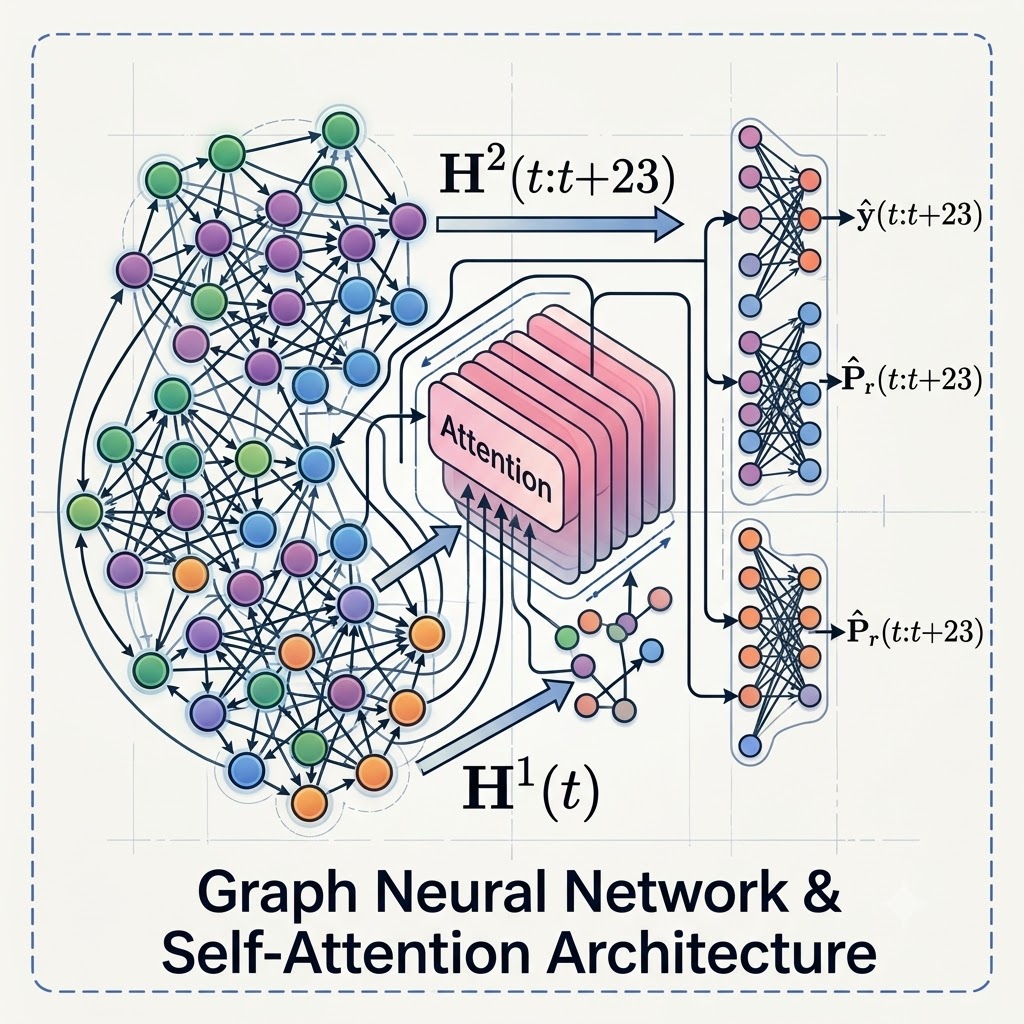
Researchers at Missouri University of Science and Technology built an attention enhanced graph convolutional network that estimates multi-period optimal power flow results in a fraction of the time needed by conventional solvers. A graph convolutional network captures how buses connect across the grid, and an attention layer tracks how load and dispatch shift from hour to hour. One of
its key innovations is that it jointly predicts generator dispatch, transmission congestion, and locational marginal prices in a single pass instead of solving each separately. Tested on the IEEE 118 bus system and a version built from real MISO load data, the model matched the accuracy of a full Gurobi solve.
Value Proposition
This technology gives grid operators the speed they need for real-time use without losing the accuracy of full optimization. That speed unlocks near real-time market analysis, large-scale scenario studies, and digital twin applications, uses that simply aren’t practical with a solver that takes minutes to return one answer. In testing, the model produced estimates for all 37 test days in a fraction of a second on a GPU, compared to over eleven minutes for a traditional solver, a speedup of nearly 30000 times.
Development Stage
Validated in simulation on the IEEE 118 bus system and a modified version built from real MISO load data.
Intellectual Property
Provisional Patent Application Filed
Inventors
Rui Bo and Liheng Lyu
Follow Technology Transfer and Economic Development