
Case Number: 23MST022
Manager: Robert Prosak
Director, IP & Licensing
S&T Technology Transfer & Economic Development
robert.prosak@mst.edu
PDF Download: Automated Insect Detection And Response Prescription Marketing Slick
Publication: Automated Insect Detection And Response Prescription Publication
Opportunity
Seeking a licensing and development partner to bring this system to commercial scale for row crop farms.
Problem Statement
Insect pests like corn rootworm beetles and aphids can devastate a crop fast. Most farms still rely on manual scouting to track them, which is tedious, slow, and expensive. Without knowing exactly where an infestation is, farmers spray the whole field, even when pests cluster in just a few spots. This wastes chemicals, degrades soil, contaminates nearby water, and speeds up pesticide resistance over time. Existing smart farm systems only log data, so they don’t show where the bugs are or how much to spray. Many also need cellular or Wi-Fi service, which isn’t available on most farmland.
Solution
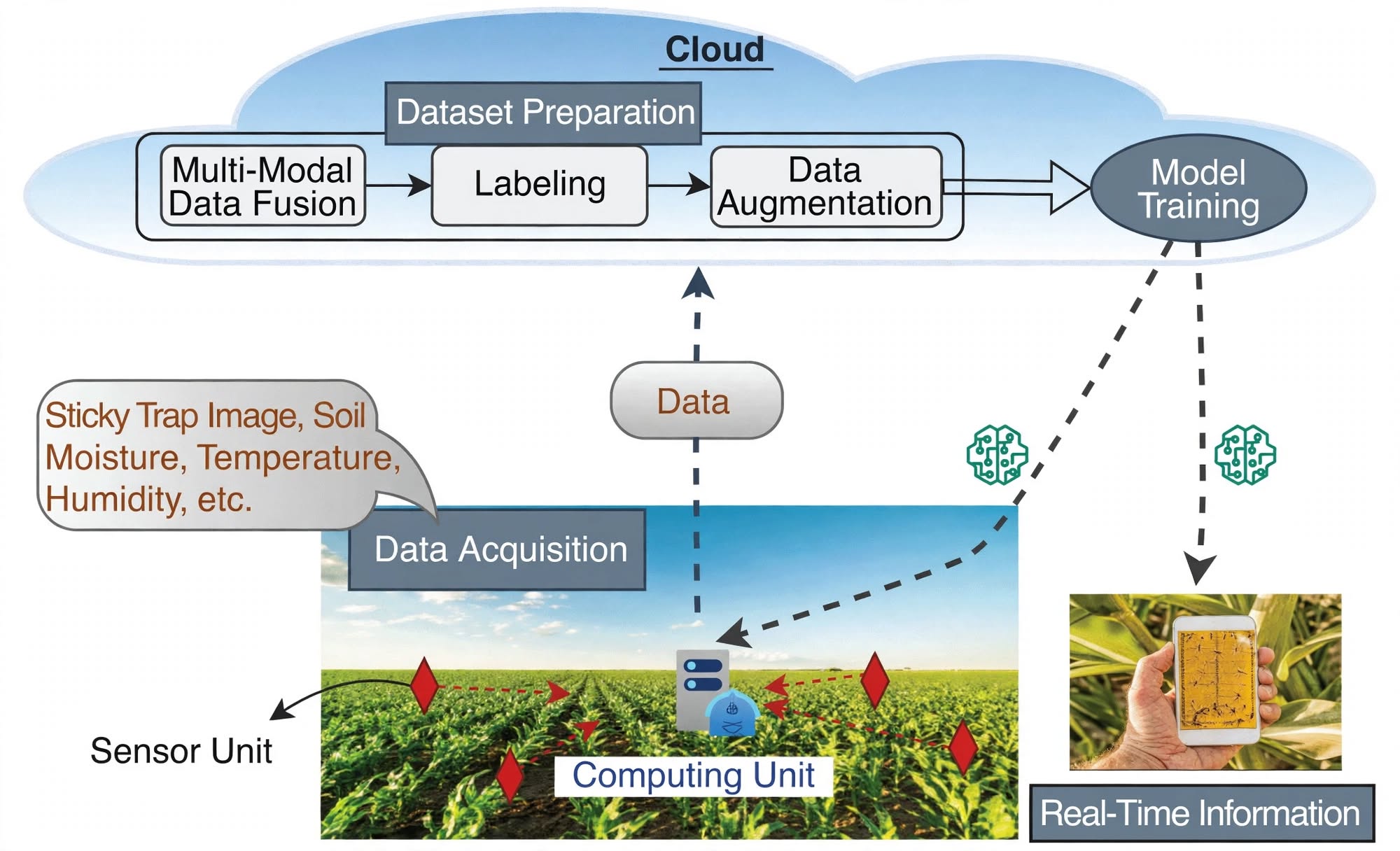
Researchers at Missouri University of Science and Technology built a field system to address a gap in insect pest monitoring and treatment. Current field monitoring can miss timely, precise treatment decisions because insect observations and field
conditions are not always captured together. To address this, researchers placed small sensor stations across a field with a camera, a sticky insect trap, and soil moisture and pH sensors. Each station photographs its trap and runs an on-device YOLO based model to count and identify the insects it catches. A long-range LoRa radio then sends that data straight to a central processor. It can reach up to three miles with a clear line of sight, no cell or Wi-Fi required. The processor combines the insect counts with the sensor readings to prescribe the exact type, amount, and location of insecticide needed. It then sends that recommendation straight to the farmer’s phone or computer.
Value Proposition
The system replaces guesswork and blanket spraying with a real-time picture of pest pressure. Farmers get exact guidance on where, when, and how much insecticide to apply. That cuts chemical use and cost while easing the environmental toll of over spraying. Because it runs on affordable hardware and needs no cell or Wi-Fi coverage, it fits the rural, low-connectivity fields where most farming actually happens.
Development Stage
Field tested across twenty working farms in Iowa, with additional pilots completed in Indiana, Missouri, and Illinois during the most recent growing season. The detection model has also been expanded to identify striped cucumber beetles, Japanese beetles, stink bugs, and berry moths.
Intellectual Property
Utility Patent Application Filed
Inventors
Amit Nath Jha, PhD Candidate, Vishesh Kumar Tanwar, PhD, Ashish Gupta, PhD, and Sajal K. Das, PhD
Follow Technology Transfer and Economic Development