
Case Number: 19MST032
Manager: Robert Prosak
Licensing Associate, Business Development
S&T Technology Transfer & Economic Development
robert.prosak@mst.edu
PDF Download: Breathable Paints for Indoor Air CO2 Control in Smart Buildings Marketing Slick
Publication: Breathable Paints for Indoor Air CO2 Control in Smart Buildings Publication
Opportunity
Seeking a licensing and development partner to scale into commercial paint production.
Problem Statement
People release CO2 whenever they occupy a space. Unlike many indoor pollutants, the source cannot be removed while the space is in use. Buildings rely on ventilation to keep CO2 under control. Heating and cooling consume substantial energy from outdoor air. Elevated CO2 can impair cognition and productivity. There is a need to reduce peak CO2 levels without increasing ventilation demand.
Solution
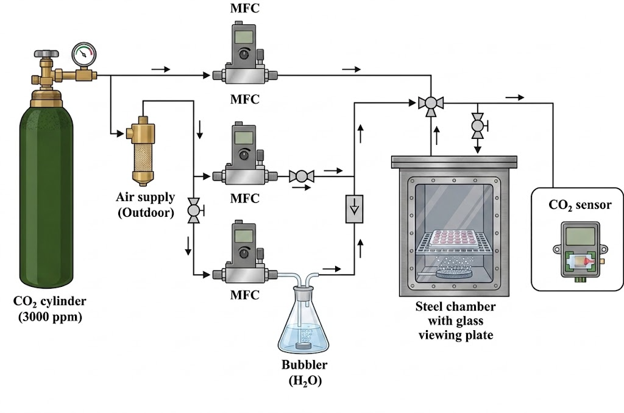
Researchers at Missouri University of Science and Technology have developed a paint coating that captures and releases CO2 on its own. The coating pairs a porous silica material with amine compounds and blends this sorbent into standard latex paint. Once applied to interior walls, the coating absorbs CO2 when a room fills with people and releases it back when the room empties, smoothing out peak CO2 levels over the course of a day. Chamber testing confirmed the coating adsorbs and desorbs CO2 repeatedly across multiple cycles without significant loss in capacity, and it performs even better at higher humidity.
Value Proposition
Studies show workers are more productive in lower CO2 environments. This paint formulation technology lowers peak indoor CO2 without added equipment or increased airflow. It applies with a standard brush or roller and builds on existing latex paint formulations, so it does not require new manufacturing infrastructure. Because it works passively, the coating could lower peak CO2 and reduce the energy used to condition outdoor ventilation air.
Development Stage
Validated in a benchtop chamber system
Intellectual Property
US Patent No. 11,702,564
Inventors
Fateme Rezaei, PhD, Thomas P. Schuman, PhD, and Glenn C. Morrison, PhD
Follow Technology Transfer and Economic Development