
Case Number: 25MST033
Manager: Robert Prosak
Director, IP & Licensing
S&T Technology Transfer & Economic Development
robert.prosak@mst.edu
PDF Download: Carbon-negative cementitious binders containing large-volume magnesium carbonate polymorphs PDF
Publication: Coming Soon
Opportunity
Seeking a licensing and development partner to advance this technology from lab scale validation toward field trials and commercial deployment.
Problem Statement
Portland cement is one of the most widely produced materials on Earth. More than 4.5 billion metric tons are made every year. Producing a ton of cement typically releases close to a ton of CO₂ into the atmosphere. These emissions account for nearly 10% of global human-caused carbon emissions. Existing low-carbon alternatives fall short in practice. Some require high-pressure CO₂ curing chambers, limiting their use to prefabricated parts. Others set too quickly for crews to use them on a job site. The industry needs a truly carbon-negative cement that behaves like the Portland cement builders already trust.
Solution
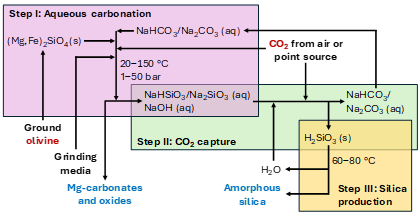
Researchers at Missouri University of Science and Technology have developed a new class of magnesium cement that is carbon-negative by design. The binder combines large amounts of magnesium carbonate with reactive magnesium oxide. Both can be produced from common magnesium silicate rock and mine tailings without an energy-intensive industrial process. When mixed with water, the cement sets and hardens much like ordinary Portland cement. It gains strength early and remains durable over the long term. Compressive strength can be tuned from 20 to 80 MPa, and 28-day strength regularly exceeds 40 MPa. It works with sand, gravel, and standard admixtures, so it can be used in ready-mix and precast operations without new equipment. The same process can reduce the carbon footprint per ton of cement from roughly 0.9 tons of CO₂ to about 0.1 tons. Some formulations achieve a negative carbon footprint.
Value Proposition
No prior magnesium cement has combined carbon negativity, cast-in-place performance, tunable strength, and a low-cost, abundant feedstock in one product. This one does. A partner enters a construction materials market under strong pressure to decarbonize with a cement that already delivers standard hydraulic cement performance.
Development Stage
Validated in the lab with multiple formulations demonstrating consistent setting behavior, compressive strength, water stability, and chloride resistance.
Intellectual Property
Provisional Patent Application Filed
Inventors
Hongyan Ma , PhD and Jihui Qin, PhD
Follow Technology Transfer and Economic Development