
Case Number: 25MST031
Manager: Robert Prosak
Director, IP & Licensing
S&T Technology Transfer & Economic Development
robert.prosak@mst.edu
PDF Download:CO2-Infused Steel Fiber Technology For Concrete Marketing Slick
Publication: Coming Soon
Opportunity
Seeking a licensing and development partner to scale this carbon-capturing concrete reinforcement technology toward commercial manufacturing.
Problem Statement
Cement production accounts for roughly 8% of global anthropogenic CO₂ emissions, making concrete one of the largest industrial contributors to climate change. Current methods to reduce concrete’s carbon footprint each carry serious drawbacks. External CO₂ injection requires specialized gas delivery systems and high-pressure curing chambers, both costly and impractical at scale.
Passive carbonation relies on slow atmospheric absorption that takes years to meaningfully sequester carbon. Conventional steel fiber reinforcement improves strength but does nothing to address emissions. The construction industry needs a reinforcement material that improves concrete performance while actively capturing and utilizing CO₂ during the mixing and curing process itself.
Solution
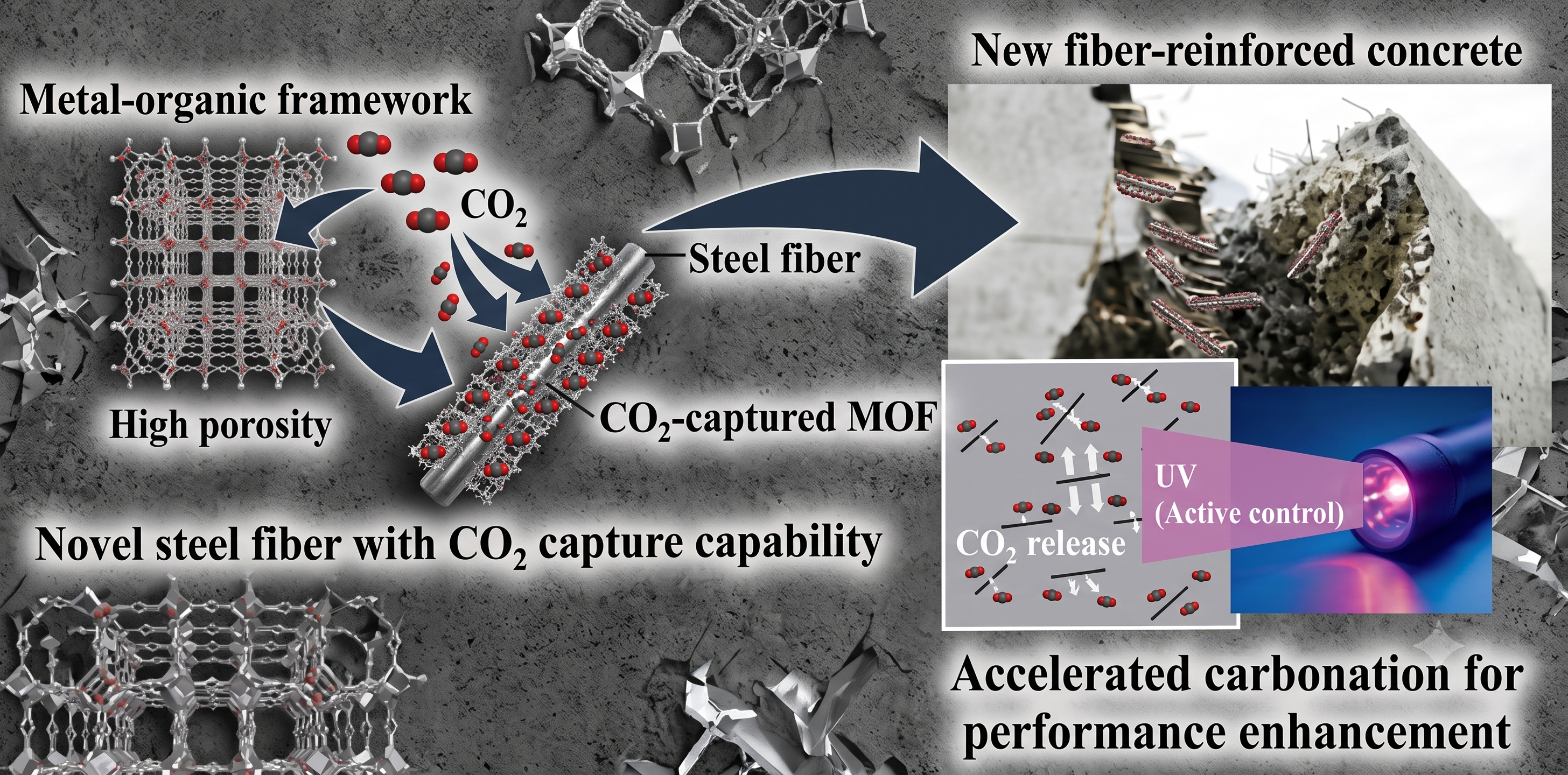
Researchers at Missouri University of Science and Technology have developed CO₂-Infused Steel Fiber Technology. Steel fibers coated with Metal-Organic Framework (MOF) material absorb CO₂ from the atmosphere before mixing. During curing, ultraviolet light triggers a controlled release of the stored CO₂, timed precisely with cement hydration to strengthen the concrete’s microstructure.
Value Proposition
CO₂-Infused Steel Fiber Technology delivers reinforcement and carbon sequestration in a single product, with no gas injection equipment, pressure chambers, or external CO₂ supply required. The fibers drop into existing ready-mix workflows and improve crack resistance, shrinkage, and curing performance while locking captured CO₂ into the concrete itself. Well suited for EV charging stations, wind and solar foundations, and carbon-neutral construction, where verifiable low-carbon materials command a premium.
Development Stage
Laboratory validation in progress.
Intellectual Property
Provisional Patent Application Status: Filed
Inventors
Jonghyun Park, PhD, Seongho Han, PhD and Kamal Kayat, PhD
Follow Technology Transfer and Economic Development