
Case Number: 22MST004
Manager: Robert Prosak
Director, IP & Licensing
S&T Technology Transfer & Economic Development
robert.prosak@mst.edu
PDF Download: Conformance Improvement in Hydrocarbon-Bearing Reservoir Using Green Crosslinkers Marketing Slick
Publication: Conformance Improvement in Hydrocarbon-Bearing Reservoir Using Green Crosslinkers Publication
Opportunity
Seeking a licensing and development partner to advance this crosslinker technology toward field trials and commercial deployment.
Problem Statement
Polymer gels control excess water and gas production in oil and gas reservoirs by plugging high-conductivity zones and redirecting fluid toward unswept oil. These insitu systems rely on a polymer and a crosslinker. Common crosslinkers include metals such as aluminum, chromium, and zirconium, along with organic compounds such as phenol formaldehyde and polyethyleneimine. Most countries have phased out metal and phenol formaldehyde crosslinkers because of their toxicity and carcinogenicity. Polyethyleneimine performs well but is highly toxic to aquatic life and has been phased out from the Norwegian side of the North Sea. Chitosan is a safer alternative but has limited water solubility. It precipitates above pH 6 and separates when diluted by alkaline formation water. Therefore, a crosslinker that is environmentally safe and stable across the pH and temperature ranges found in real reservoirs is still needed.
Solution
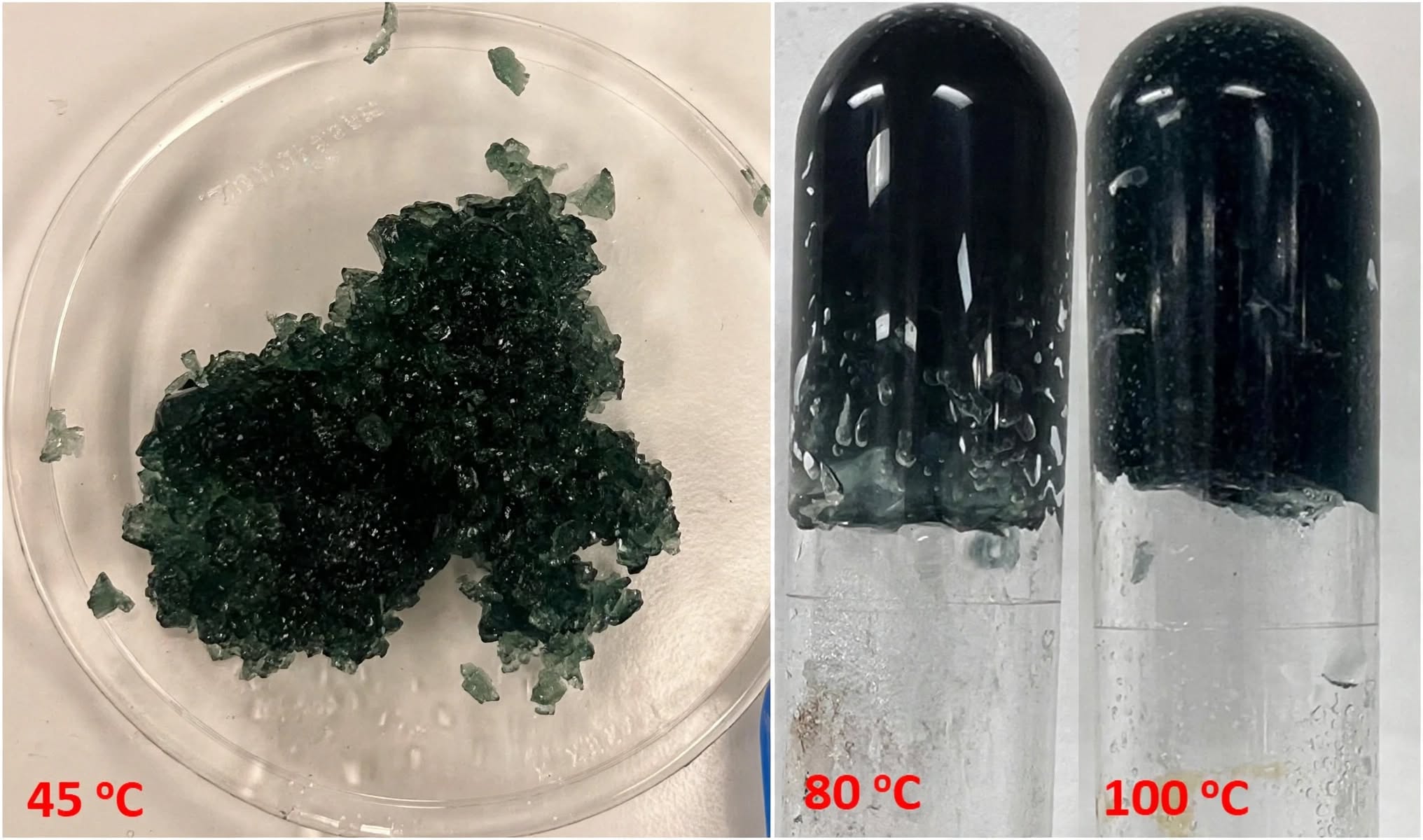
Researchers at Missouri University of Science and Technology have developed a green crosslinker made from amino acid compounds such as lysine. This crosslinker reacts with the amido groups on common acrylamide-based polymers already used across the oilfield. It stays effective across a broad pH range of 2 to 10 and works at reservoir temperatures from 80°C to 130°C, with crosslinking times tunable from hours to weeks. The polymer and crosslinker can be mixed and stored at 65°C or below for 30 days or longer, in some cases up to a year, without reacting prematurely. Once the mixture reaches reservoir temperature, it crosslinks into a strong, stable gel that plugs fractures and high-permeability channels.
Value Proposition
This crosslinker offers operators a safer option than today’s metal, phenolformaldehyde, and polyethyleneimine systems, with toxicity levels (LC50 and EC50) of at least 50 mg/L. In core flooding tests on 5 Darcy sandstone, the resulting gel reached a breakthrough pressure of 1,440 psi per foot and a plugging efficiency above 99.9%. Its broad pH and temperature range, along with months of storage stability before activation, make it a practical option for improving conformance in high-temperature reservoirs where existing systems remain limited.
Development Stage
Validated in the lab.
Intellectual Property
Non-Provisional Patent Application Filed
Inventors
Tao Song,PhD, Baojun Bai, PhD, Thomas Schuman, PhD and Mohamed Ahdaya, PhD
Follow Technology Transfer and Economic Development