
Case Number: 15MST025
Manager: Robert Prosak
Director, IP & Licensing
S&T Technology Transfer & Economic Development
robert.prosak@mst.edu
PDF Download: Cyclic regeneration of nanostructured composites for catalytic applications PDF
Publication: Cyclic regeneration of nanostructured composites for catalytic applications Publication
Opportunity
Seeking a licensing and development partner to advance this regenerable anode technology toward commercial solid oxide fuel cell systems.
Problem Statement
Solid oxide fuel cells (SOFCs) offer fuel flexibility, high efficiency, and the ability to co-generate heat and power. Wide adoption has been limited by anode materials that lose performance over time. Catalytic activity in SOFC anodes depends on nanosized metal particles with high surface area. These particles coarsen at operating temperatures, shrinking their surface area and reducing catalytic activity and power density as the cell ages. Once coarsened, conventional anode materials cannot recover their original performance. Anode materials therefore need to be regenerable so catalytic activity can be restored over repeated duty cycles.
Solution
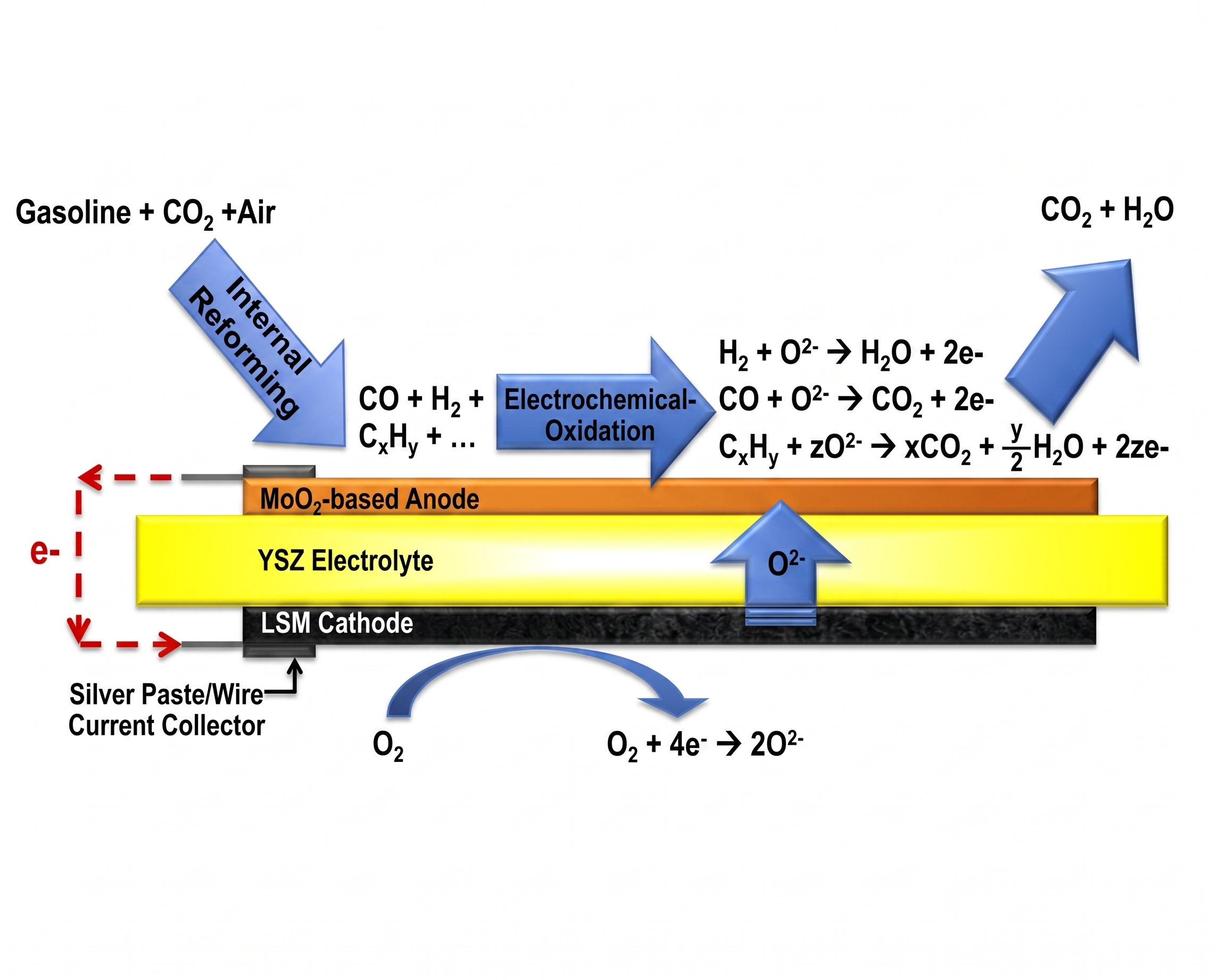
Researchers at Missouri University of Science and Technology have developed a cermet anode material that regenerates itself through simple oxidation and reduction steps. The anode starts as a metal oxide solid solution, such as copper molybdate, infiltrated into a porous zirconia scaffold or deposited directly on a dense electrolyte. In a reducing atmosphere, the oxide separates into nanosized metal and metal oxide particles that drive catalytic activity, typically 1 to 500 nanometers in size. As the cell operates, these particles coarsen to 0.5 to 3 micrometers and lose activity. Oxidizing the anode reforms the original solid solution, and reducing it again redisperses the particles back down to nanoscale size. For the copper molybdate system, this cycle runs at 400°C for reduction and 600°C for oxidation, both within standard SOFC operating conditions. More broadly, the approach can be tuned by pairing copper, nickel, cobalt, or titanium with molybdenum, tungsten, or cerium oxides to target different operating temperatures and fuels.
Value Proposition
This technology addresses a core barrier to SOFC durability. Anode particles coarsen with use, and catalytic activity falls off over time. Rather than replacing a degraded anode, its performance can be restored through straightforward redox cycling. Cells built with this anode have been fabricated and tested between 400°C and 800°C, running on hydrocarbon fuels including methane, propane, and vaporized gasoline, not just hydrogen. The materials platform also supports oxide combinations with
higher melting points and lower vapor pressure for higher-temperature operation.
Development Stage
Validated in the lab.
Intellectual Property
Granted U.S. Patent No. 10,516,170
Inventors
Fatih Dogan, PhD
Follow Technology Transfer and Economic Development