
Case Number: 16MST033
Manager: Robert Prosak
Director, IP & Licensing
S&T Technology Transfer & Economic Development
robert.prosak@mst.edu
PDF Download: Distributed Flow Battery For Transport Systems
Publication Download: Distributed Flow Battery For Transport Systems
Opportunity
Seeking a licensing and development partner to scale a distributed flow battery architecture
into manufacturing for electric vehicles and transport applications.
Problem Statement
Lithium-ion batteries have well-known shortcomings in transport applications due to slow recharging, short service lives, and bulky
designs. Flow batteries address most of these problems with better cycle life, deeper discharge tolerance, and the ability to refuel instantly by swapping electrolyte. But their conventional block-shaped cell design wastes space in a vehicle and forces compromises that have kept them out of the transport market. The cells are also limited by membrane surface area which directly caps the power they can deliver.
Solution
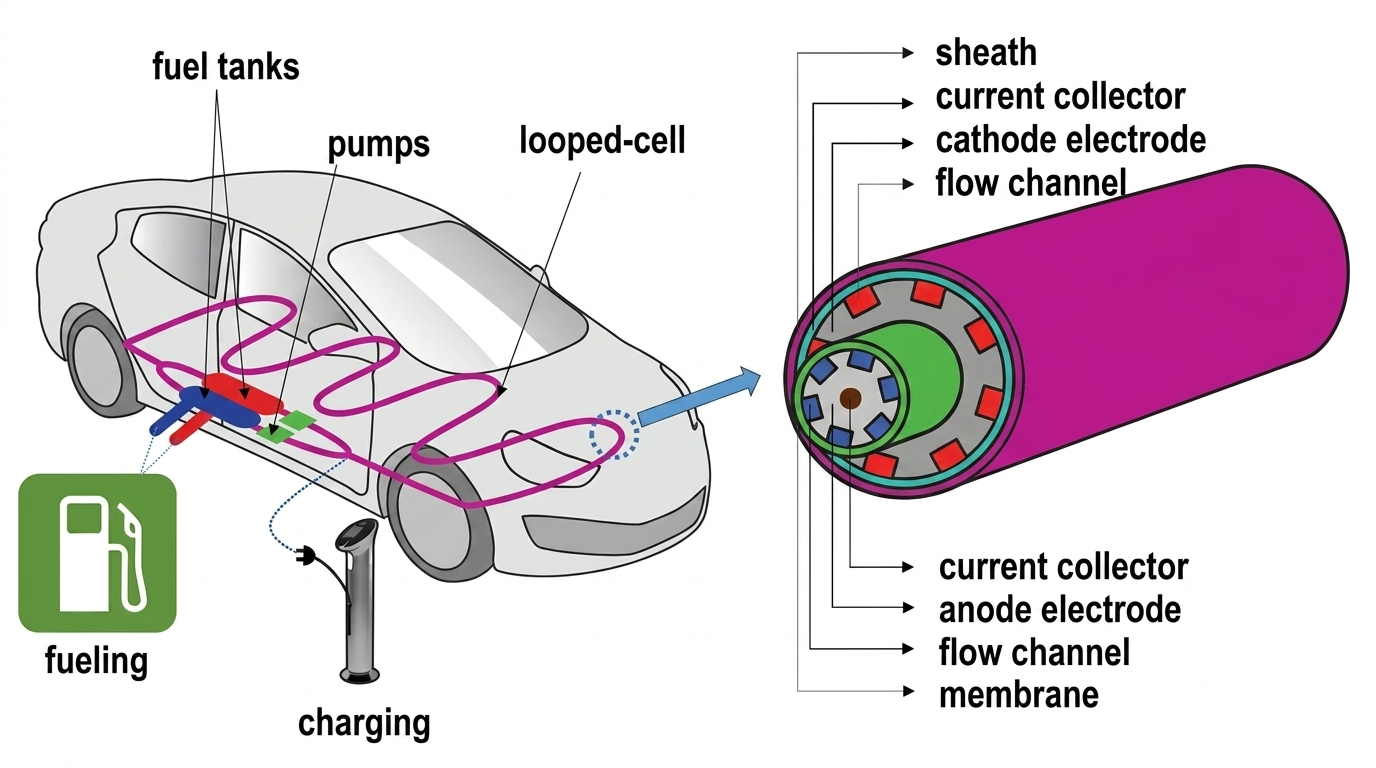
Researchers at Missouri University of Science and Technology have developed a distributed flow battery architecture in which the reaction cell is elongated and tubular and is routed through the vehicle in a serpentine configuration the way wiring works. An exterior flexible polymer sheath allows the cell to bend through the available space within the chassis. The architecture maximizes membrane surface area relative to cell volume because the membrane area scales with cell length rather than block volume.
This directly increases electrical power. Modeling showed the distributed cell can deliver the same maximum voltage at 25 percent less state of charge compared to a conventional system. A 10 cm experimental cell demonstrated a stable 1.7-volt waveform across charge-discharge cycles.
Value Proposition
The distributed architecture puts flow battery capacity into the unused spaces of a vehicle instead of forcing the vehicle to make room for a battery block. This improves space utilization and weight distribution. It also raises power density by maximizing membrane area within a given cell volume. The flexible polymer sheath is compatible with existing manufacturing methods and standard vanadium electrolyte chemistry, so a licensee can adopt the architecture without retooling upstream supply chains.
Development Stage
Validated at lab scale with an experimental 10 cm reaction cell and modeling of distributed configurations.
Intellectual Property
10,367,221
Inventors
Jonghyun Park, PhD and Mohammed Abdulkhabeer Al-Yasiri, PhD
Follow Technology Transfer and Economic Development