
Case Number: 26MST013
Manager: Robert Prosak
Director, IP & Licensing
S&T Technology Transfer & Economic Development
robert.prosak@mst.edu
PDF Download:Distributed temperature monitoring of oxy-fuel injector panel of Electric Arc Furnace (EAF) via Fiber Optic Sensor Marketing Slick
Publication: Distributed temperature monitoring of oxy-fuel injector panel of Electric Arc Furnace (EAF) via Fiber Optic Sensor Publication
Opportunity
Seeking a licensing and development partner to scale this sensor system into commercial deployment across electric arc furnace steelmaking operations.
Problem Statement
Electric arc furnaces (EAFs) already cut carbon intensity by nearly half compared to traditional steelmaking by utilizing recycled steel scrap as the primary raw material. Modern EAFs rely on oxy-fuel injectors to support solid scrap melting and refine the
liquid steel. However, temperature monitoring of injector panels with high spatial resolution has remained unreachable until now. Conventional sensors, such as thermocouples and resistance temperature detectors (RTDs), provide only point measurements and are susceptible to electromagnetic interference. Consequently, most plants assess panel health by monitoring the cooling water temperature, which cannot detect a localized hot spot. As a result, adverse operating conditions including flame blowback, excessive arc exposure, and inadequate slag coverage, can quietly damage the panel and lead to catastrophic failure.
Solution
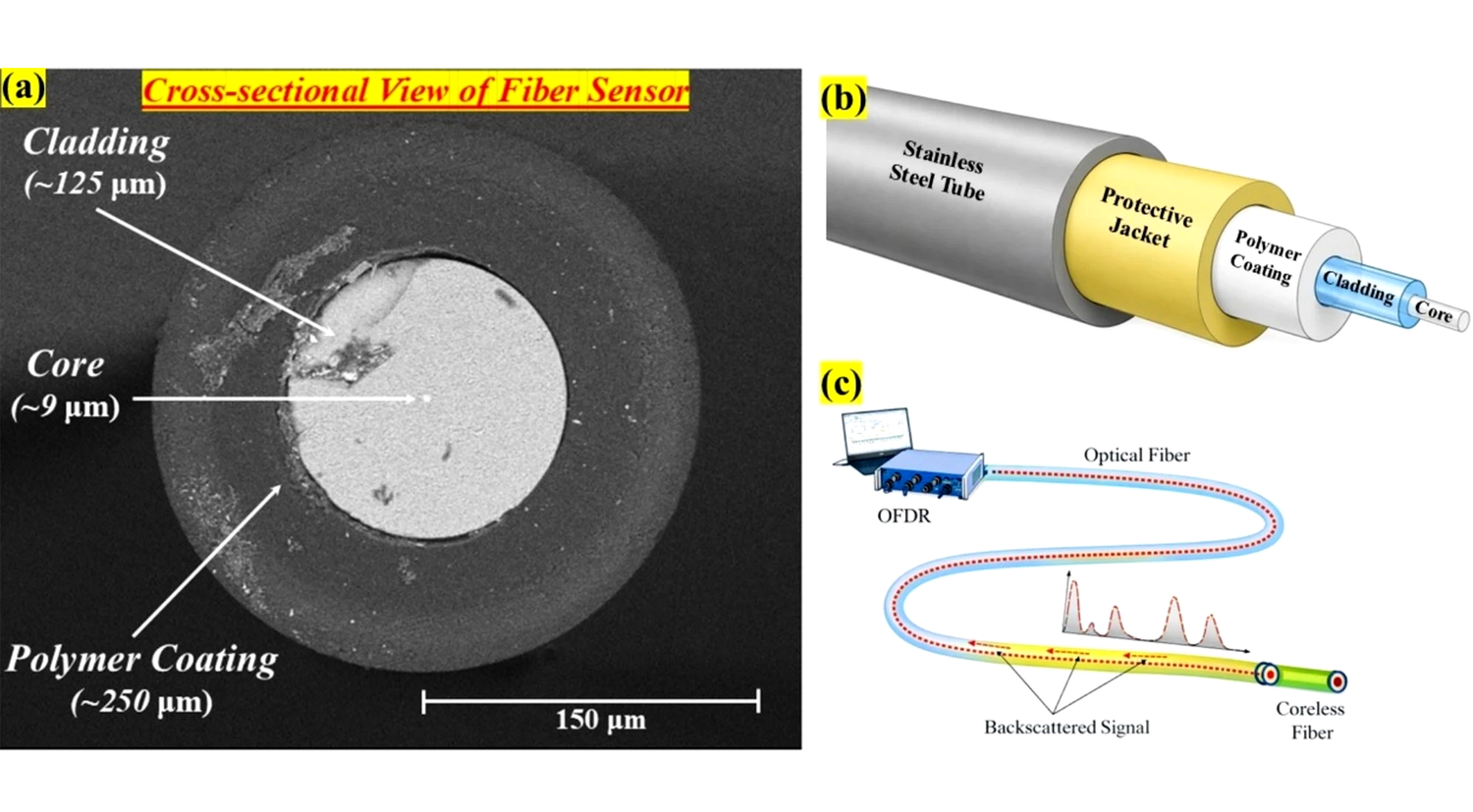
Researchers at Missouri University of Science and Technology solved this by embedding fiber-optic sensors directly into the copper burner block of an EAF injector panel. The sensors use Rayleigh backscattering to continuously measure temperature along their length. In an industrial trial, they collected over 100,000 temperature data for two consecutive days. Four sensors were embedded in the panel, and temperature data was collected at every 2.5 millimeter, equivalent to employing more than 300 thermocouples. Because the sensors are optical rather than electrical, they are immune to electromagnetic interference that blinds conventional sensors. The system was installed inside an active furnace at CMC Steel in Birmingham, Alabama, and ran across 47 full furnace heat cycles. The sensors were able to detect several hot spots spiking to 160°C, all of which interestingly occurred after the addition of second scrap bucket. Comparison with process data indicated these hot spots were caused by inadequate slag coverage and arc exposure, demonstrating
a level of process insight unattainable with existing sensing technologies.
Value Proposition
This is the first known deployment of Rayleigh backscattering fiber sensors for distributed thermal sensing inside an EAF oxy-fuel injector under real industrial conditions. It gives steelmakers the ability to monitor injector panel health which they
have never had before, supporting safer operation, preventive maintenance, and better efficiency across a system that can carry up to 40 percent of an EAF’s total energy load.
Development Stage
Field tested inside an operating industrial electric arc furnace.
Intellectual Property
Provisional Patent Application Filed
Inventors
Ronald J. O’Malley, Jie Huang, Koustav Dey, Mobashir Ahmed, Rony Kumer Saha and Todd Sander
Follow Technology Transfer and Economic Development