
Case Number: 24MST023
Manager: Robert Prosak
Director, IP & Licensing
S&T Technology Transfer & Economic Development
robert.prosak@mst.edu
PDF Download: Electrifed Plastic Pipe for Locatable, Information-Enabled Infrastructure
Publication: Electrifed Plastic Pipe for Locatable, Information-Enabled Infrastructure
Opportunity
Seeking a licensing and development partner to scale into manufacturing and infrastructure deployment.
Problem Statement
Plastic pipes are widely used because they are inexpensive, corrosionresistant, and easy to install. Once buried, however, they are difficult to locate and provide little information about condition, leaks, pressure, temperature, flow, or remaining service life. Infrastructure owners need plastic pipe systems that can be easily located, monitored, and managed without relying solely on excavation, records, or external sensors.
Solution
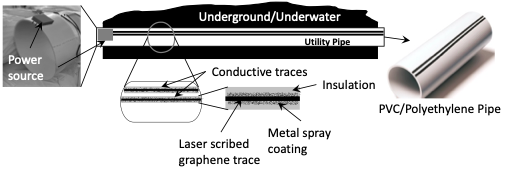
Researchers at the University of Missouri have developed a method to integrate conductive structures directly into the walls of PVC or polyethylene pipes. These structures can allow the pipe itself to emit a detectable signal and support sensing, communication, and monitoring functions. The approach delivers a practical pathway to turn ordinary plastic pipe into locatable, information-enabled infrastructure while preserving its advantages.
Value Proposition
This technology turns passive plastic pipe into the starting point for smart infrastructure. The first value is a safer, faster way to locate buried pipe before excavation. Follow-on value may include leak detection, structural health monitoring, pressure and temperature monitoring, flow-related measurements, wireless communication, and digital asset management. The platform gives pipe manufacturers and infrastructure operators a means to higher-value pipe products and more intelligent infrastructure systems.
Development Stage
Validated in the lab.
Intellectual Property
Patent pending
Inventors
Jie Huang, Rex E. Gerald II, Abhishek Prakash Hungund , Bohong Zhang, Homayoon Soleimani Dinani, Ryan O’Malley, Kelsey Vancil, Michael Lee Davis II and Thomas M Spudich
Follow Technology Transfer and Economic Development