
Case Number: 26MST039
Manager: Robert Prosak
Director, IP & Licensing
S&T Technology Transfer & Economic Development
robert.prosak@mst.edu
PDF Download: Enhanced performance of limestone calcined clay cement through limestone–clay co-calcination Marketing Slick
Publication: Enhanced performance of limestone calcined clay cement through limestone–clay co-calcination Publication
Opportunity
Seeking a licensing and development partner to scale into commercial cement manufacturing.
Problem Statement
Limestone calcined clay cement, or LC3, is one of the most promising low-carbon alternatives to ordinary Portland cement. Conventional LC 3 replaces about half of cement clinker with a blend of calcined clay and limestone and can match the durability of ordinary Portland cement at later ages. However, only the clay is thermally activated in this process, while the limestone stays untreated in the mix. This leaves early-age strength behind ordinary Portland cement and slows the rate at which LC 3 concrete can be placed into service.
Solution
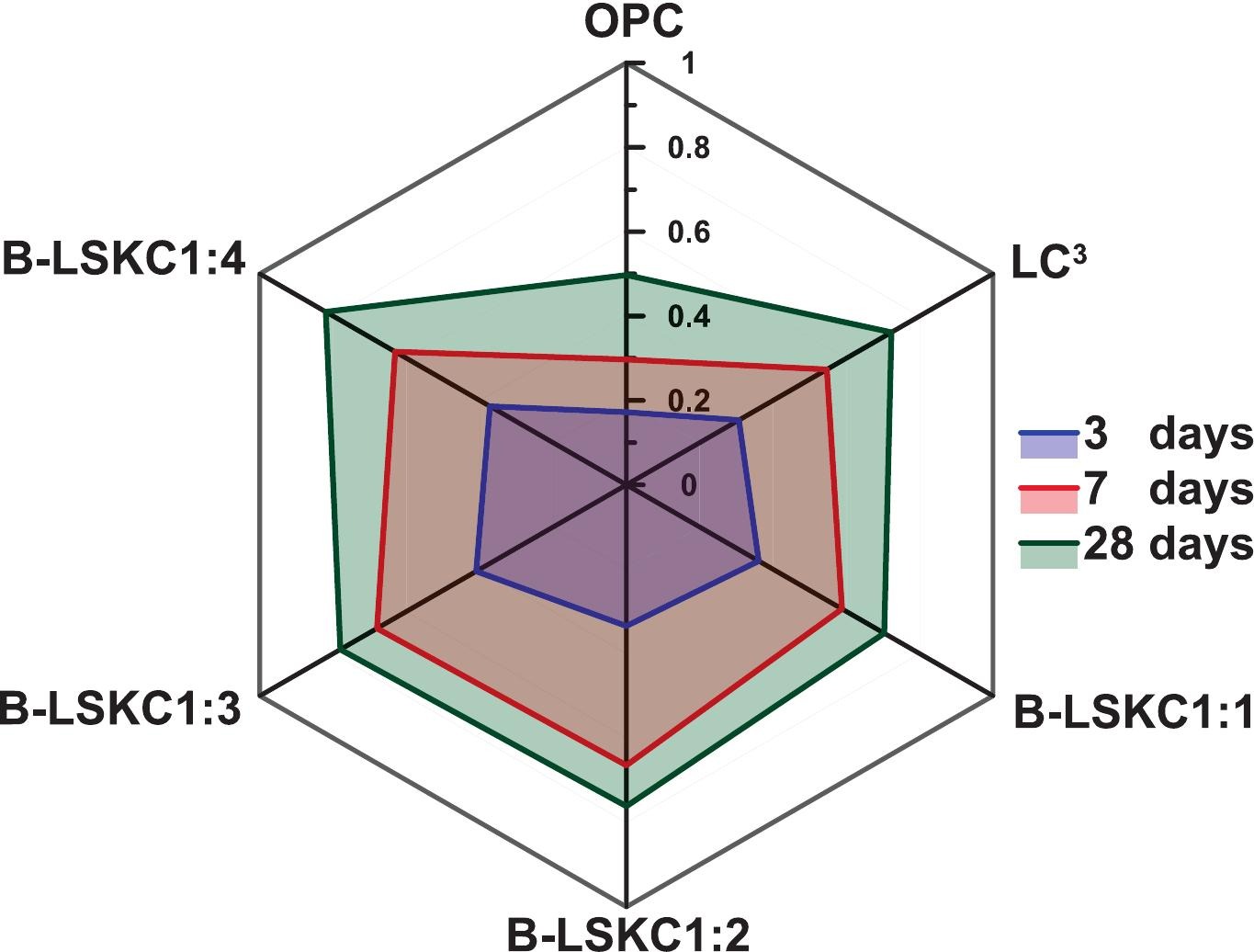
Researchers at Arizona State University and Missouri University of Science and Technology have developed a method that calcines limestone and clay together in a single thermal process rather than activating the clay alone. This co-calcination partially converts the limestone into reactive free lime while fully activating the clay into reactive metakaolin. The combined material hydrates faster and builds strength earlier than conventional LC 3. When tested against a binder of identical composition in which only the clay was calcined, the co-calcined version achieved 24% higher compressive strength at 3 days, 17% higher at 7 days, and 8.7% higher at 28 days.
Value Proposition
This method closes the early-strength gap that has limited the wider adoption of LC 3 without adding meaningful carbon cost. The additional CO2 released from partially calcining the limestone stayed minimal, so the co-calcined blends kept embodied carbon in line with conventional LC 3 while still cutting clinker content in half. Several of the co-calcined mixes also delivered higher
compressive strength per unit of CO2 emitted than conventional LC 3 over the tested curing period. The co-calcination step takes place in the same calciner already used to activate clay in conventional LC3 production.
Development Stage
Validated in the lab through paste-and-mortar testing up to 28 days of curing.
Intellectual Property
Provisional Patent Application Filed
Inventors
Aditya Kumar, Oluwadamilare Adesina, Narayanan Neithalath
Follow Technology Transfer and Economic Development