
Case Number: 25MST005
Manager: Robert Prosak
Director, IP & Licensing
S&T Technology Transfer & Economic Development
robert.prosak@mst.edu
PDF Download: Fast Penetration probe test for characterizing rheological properties of fresh concrete Marketing Slick
Publication:Fast Penetration probe test for characterizing rheological properties of fresh concrete Publication #1
Fast Penetration probe test for characterizing rheological properties of fresh concrete Publication #2
Opportunity
Seeking a licensing and development partner to bring this device to market.
Problem Statement
Fresh concrete must be assessed for workability before placement, yet existing testing methods have practical limitations. Slump tests are quick and simple but provide limited information for accurate rheological characterization. Conventional rotational rheometers are often expensive and lack portability, while testing becomes increasingly challenging as mixtures stiffen, particularly for low-flowability materials used in 3D concrete printing. Slow penetration methods can be affected by material heterogeneity and typically involve prolonged monitoring of a single batch, limiting their practicality for frequent testing of successive batches during production. These limitations highlight the need for an affordable, portable, and automated method that delivers rapid, accurate measurements across flowable and stiff mixtures and accommodates both conventional concrete and thin layers deposited during 3D concrete printing.
Solution
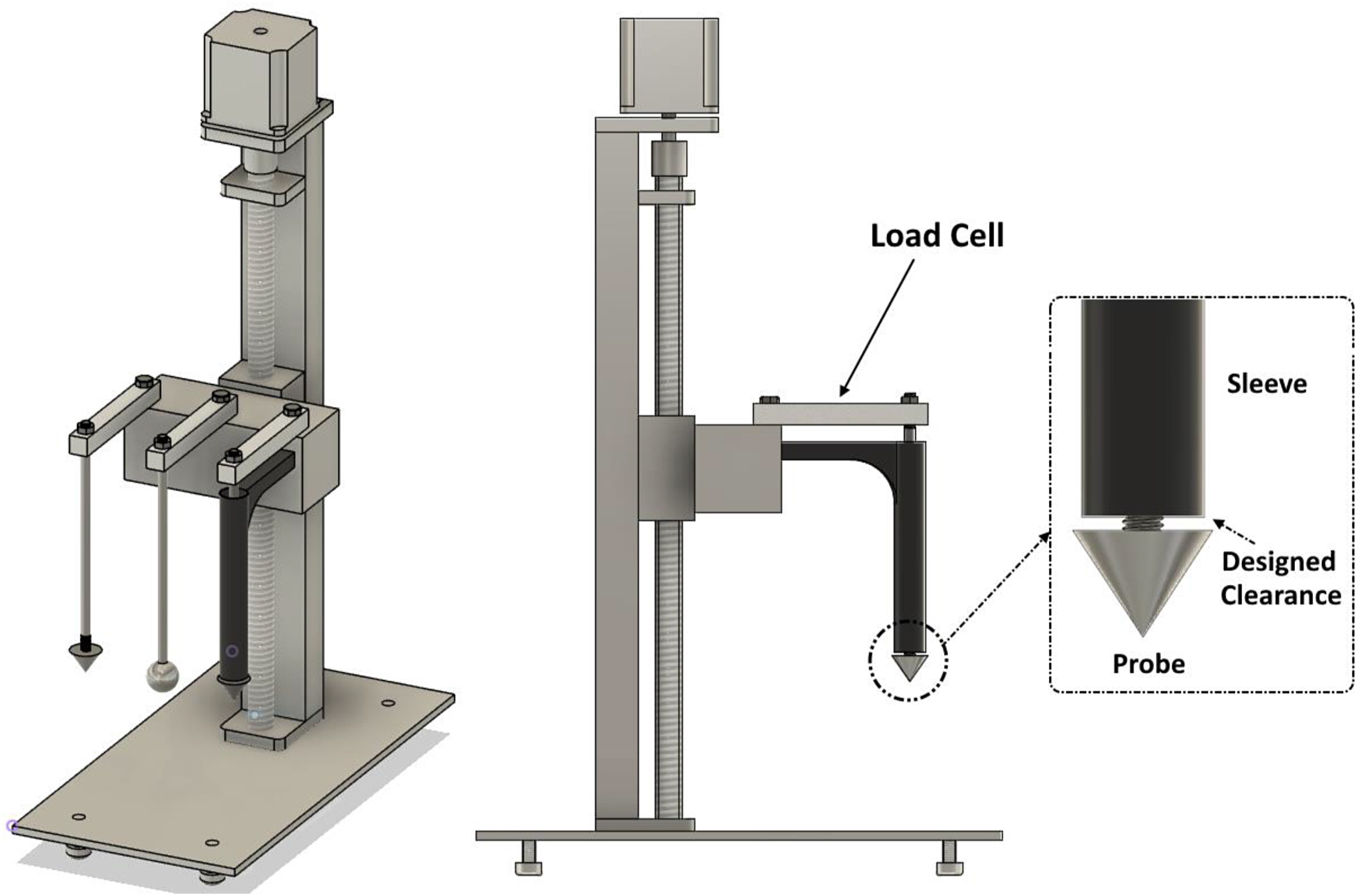
Researchers at Missouri University of Science and Technology have developed a portable, automated fast penetration device and an accompanying theoretical framework to characterize the rheological properties of fresh and partially set concrete. A controller-regulated actuator drives the probe at a constant speed while a force sensor records penetration resistance, generating synchronized force–displacement data. Based on solid plasticity theory, the framework accounts for probe geometry to convert measured penetration force into static yield stress. The technology offers two complementary testing formats: full penetration for conventional concrete where sufficient material depth is available, and shallow tip penetration for stiff mixtures and thin printed layers where full probe immersion is impractical. Adjustable stroke length and penetration speed, together with interchangeable probe tips, accommodate different testing requirements. The device supports standalone testing of samples in containers, with configurations for on-site slab testing and potential integration with a 3D concrete printer’s print head for layer-by-layer assessment.
Value Proposition
The device provides fast, accurate static yield stress measurements on site, without the delay of lab testing. Full-depth penetration typically takes well under a minute. Operators can use this feedback to adjust the mix as needed and address problems sooner. The approach could also extend to other materials, including mortars, clays, and polymer composites.
Development Stage
Prototype built
Intellectual Property
Non-Provisional Patent Application Filed
Inventors
Nicolas Libre, PhD and Ali Fasihi PhD
Follow Technology Transfer and Economic Development