
Case Number: 23MST009
Manager: Robert Prosak
Director, IP & Licensing
S&T Technology Transfer & Economic Development
robert.prosak@mst.edu
PDF Download:In Situ High-Temperature Raman Spectroscopy via a Remote Fiber-Optic Raman Probe Marketing Slick
Publication #1:In Situ High-Temperature Raman Spectroscopy via a Remote Fiber-Optic Raman Probe Publication #1
Publication #2:In Situ High-Temperature Raman Spectroscopy via a Remote Fiber-Optic Raman Probe Publication #2
Publication #3:In Situ High-Temperature Raman Spectroscopy via a Remote Fiber-Optic Raman Probe Publication #3
Opportunity
Seeking a licensing and development partner to move the sensor from lab validation into industrial trials and full scale deployment.
Problem Statement
Industries that process molten glass, slag, and similar high-temperature materials need to know a melt’s chemistry while it is still molten. Today, that mostly means pulling a sample and testing it offline, which takes time the process doesn’t have. Benchtop Raman systems can measure that chemistry with precision, but they are not portable and cannot handle the size or heat of an industrial melt. Fiber optic Raman probes solve the portability problem in fields like biology and medicine, but their fiber materials cannot survive being placed near a molten material at steelmaking temperatures. As a result, no probe existed that could sit close to a melt at up to 1400°C and still send a clean signal back to a spectrometer.
Solution
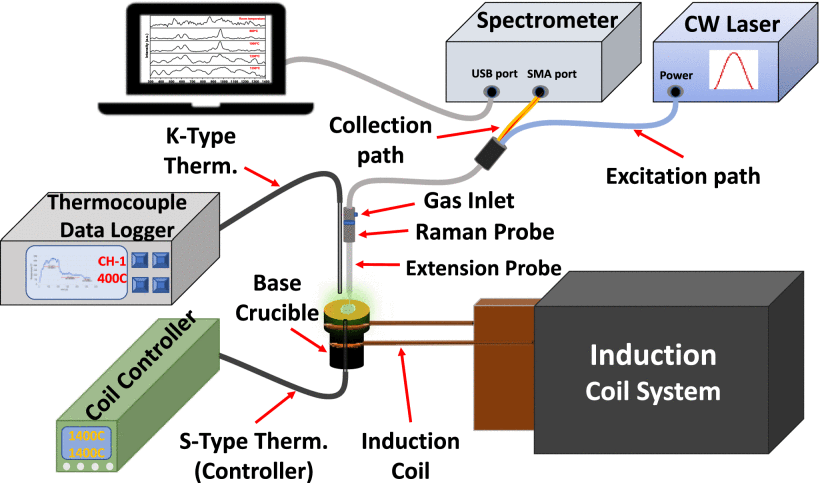
Researchers at Missouri University of Science and Technology built a fiber-optic Raman probe to measure molten samples up to 1400°C without touching them. The probe uses a customized external telescope on its tip, which extends its working distance and shields it from the heat. A deconvolution algorithm then breaks down the collected Raman spectrum and links each peak to the melt’s underlying molecular structure. The team tested the probe on electric arc furnace slag, continuous casting mold flux, and bioactive glass, and its readings tracked closely with known composition, basicity, and viscosity for each sample.
Value Proposition
Existing Raman probes cannot operate right next to molten steel at steelmaking temperatures without being damaged by heat. This first Raman probe replaces slow offline sampling with a real-time reading, providing faster feedback for process control and new insight into how a melt’s chemistry shifts as it heats and cools. The correlations it produced against composition and viscosity held up across synthetic and real industrial flux samples, not just idealized lab conditions.
Development Stage
Validated in the lab and demonstrated in real time on electric arc furnace slag, synthetic and industrial mold flux, and bioactive glass at temperatures up to 1400°C
Intellectual Property
Utility Patent Application Filed
Inventors
Ronald O’Malley, PhD, Jie Huang, PhD, Bohong Zhang, PhD and Hanok Tekle, PhD
Follow Technology Transfer and Economic Development