
Case Number: 25MST042
Manager: Robert Prosak
Director, IP & Licensing
S&T Technology Transfer & Economic Development
robert.prosak@mst.edu
PDF Download: Integrated Optical and RF Interferometry System for Enhanced Phase Sensing PDF
Publication: Integrated Optical and RF Interferometry System for Enhanced Phase Sensing Publication
Opportunity
Seeking a licensing and development partner to advance this sensing platform toward commercial deployment.
Problem Statement
Optical interferometers can catch incredibly small changes in distance and shape. But reading those changes usually requires a high-resolution spectrum analyzer. RF interferometry is the cheaper alternative. It just isn’t sensitive enough to catch the tiny phase shifts that actually matter. Engineers need a way to achieve optical-level sensitivity without the optical-level price tag.
Solution
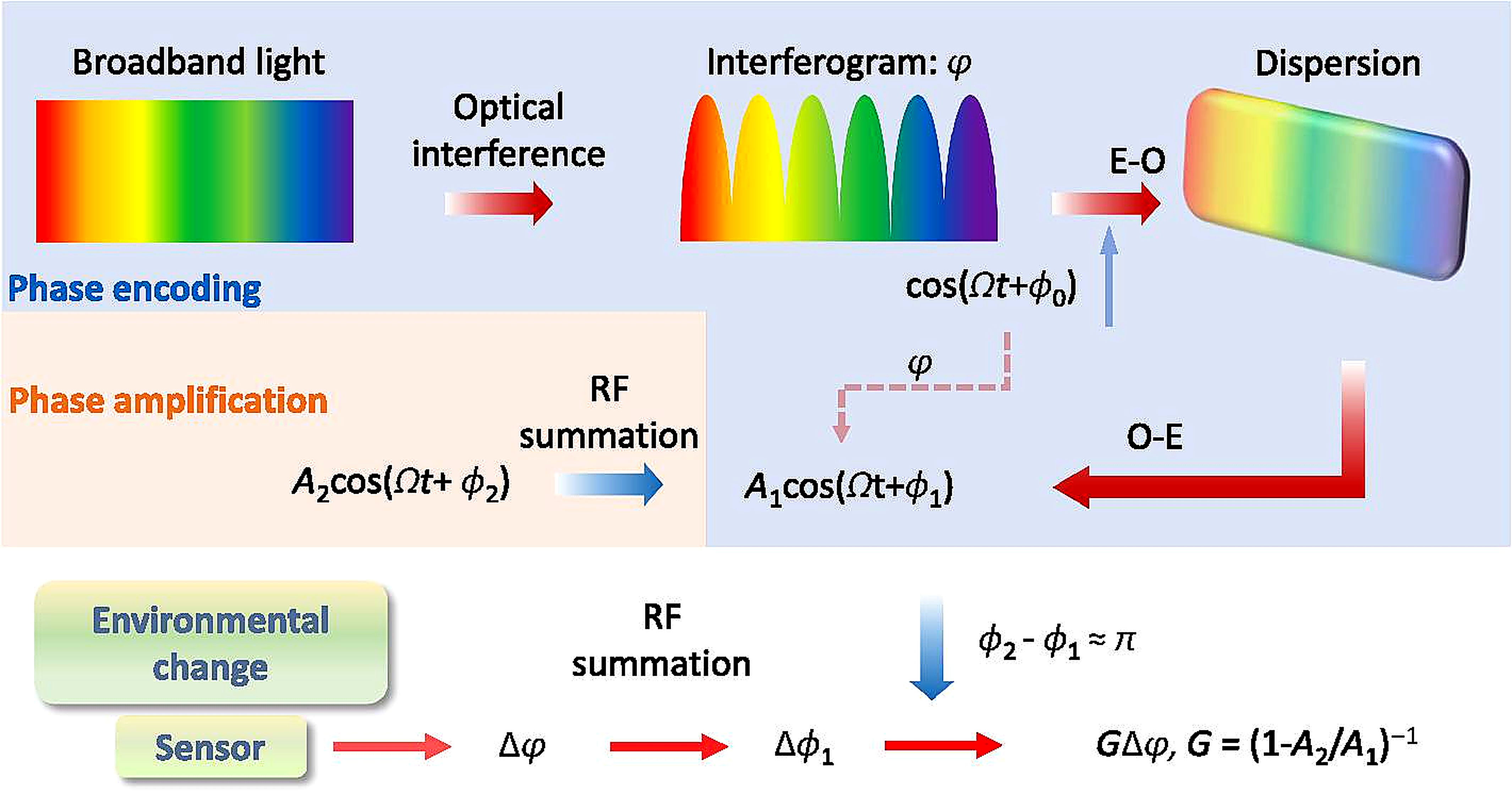
Researchers at Missouri University of Science and Technology built a system that bridges the two worlds. Their microwave photonic encoding unit converts the phase of an optical interferometer directly into the phase of an RF signal. A second RF signal is then combined with it near the point of destructive interference. This amplifies the phase shift by a gain factor that can be tuned up or down. When tested on a miniature fiber-optic Fabry-Perot sensor, the system achieved a sensitivity of 2.14 rad/nm. That’s more than 250 times the sensitivity of standard RF phase sensing. It holds up well in noisy environments and runs on everyday RF hardware rather than costly optical instruments.
Value Proposition
This technology delivers optical-grade sensitivity through RF-grade equipment. It reduces reliance on expensive optical spectrum analyzers by enabling phase readout with standard RF electronics while maintaining full sensitivity tunability. It applies to a wide range of fiber optic interferometers already used in structural health monitoring, biomedical sensing, and photonic instrumentation. That means sensor makers can add high-sensitivity phase detection without investing in costly optical instrumentation.
Development Stage
Validated in the lab.
Intellectual Property
Provisional Patent Application Filed
Inventors
Chen Zhu , Jie Huang and Ruimin Jie
Follow Technology Transfer and Economic Development