
Case Number: 26MST045
Manager: Robert Prosak
Director, IP & Licensing
S&T Technology Transfer & Economic Development
robert.prosak@mst.edu
PDF Download: Interleaved Tapped-Inductor Buck-Based Dual Active Bridge Power Electronic Converter Marketing Slick
Publication: Coming Soon
Opportunity
Seeking a licensing and development partner to bring this converter topology to market.
Problem Statement
High-conversion-ratio isolated DC-DC converters usually rely on the dual-active-bridge topology. Achieving a large step-down ratio with a DAB converter typically requires a transformer with a high turns ratio. A higher turns ratio brings more parasitic effects, more challenging transformer design, and higher secondary-side currents, all of which reduce efficiency. Two-stage designs that place a separate buck converter in front of a DAB converter can ease this but add parts and an extra conversion stage. The market needs a single-stage isolated step-down converter that does not put the entire conversion burden on the transformer alone.
Solution
Researchers at Missouri University of Science and Technology have developed a new single-stage isolated DC-DC converter. The design integrates an interleaved tapped-inductor buck converter into the primary bridge of a dual-active-bridge converter, using the same switches for both step-down and inversion. Part of the voltage step-down occurs at the primary bridge before the transformer stage, and the transformer’s turns ratio handles the rest while maintaining full galvanic isolation. A PLECS simulation of an 800VDC-to-48VDC, 1500 W design confirmed the approach and matched the theoretical model.
Value Proposition
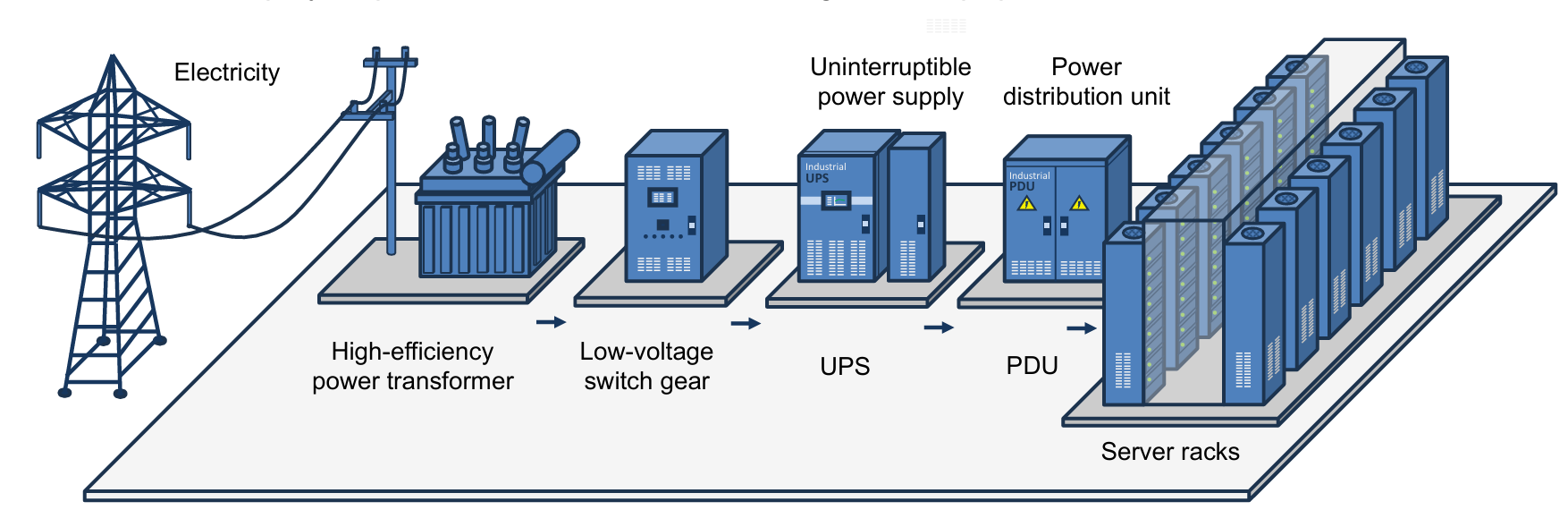
This topology provides a compact, single-stage path to high-step-down isolated power conversion for applications such as 800 V-to-48 V power delivery in AI data centers, electric vehicles, and renewable energy systems. By sharing the stepdown task between the primary bridge and the transformer, the design reduces the transformer’s turns ratio required for a given conversion ratio. That means lower
secondary-side currents, lower conduction loss, lower switch stress, and better efficiency. It also uses fewer parts than a conventional two-stage buck-plus-DAB setup.
Development Stage
Validated through PLECS simulation of an 800 VDC to 48 VDC, 1500 W design.
Intellectual Property
Provisional Patent Application In Preparation
Inventors
Amirhossein Habibi and Mehdi Ferdowsi
Follow Technology Transfer and Economic Development