
Case Number: 24MST030
Manager: Robert Prosak
Director, IP & Licensing
S&T Technology Transfer & Economic Development
robert.prosak@mst.edu
PDF Download: Laser Foil Printed Embedded Wireless Sensors for Structural Health Monitoring
Publication Download: Laser Foil Printed Embedded Wireless Sensors for Structural Health Monitoring
Opportunity
Seeking a licensing and development partner to scale into manufacturing and advance toward commercialization.
Problem Statement
Structural health monitoring is critical for bridges, aircraft, wind turbines, military assets, and other load-bearing systems where unexpected failure can cause major safety and economic consequences. However, reliable sensing inside metal structures
remains difficult. Surface-mounted sensors are exposed to damage, environmental degradation, and detachment. Conventional approaches for embedding sensors during metal additive manufacturing can introduce size limitations, alignment
challenges, wiring complexity, and short-circuit risks during laser processing. The field needs a manufacturing method that can place small, passive, wireless sensors directly inside metal structures while preserving structural integrity.
Solution
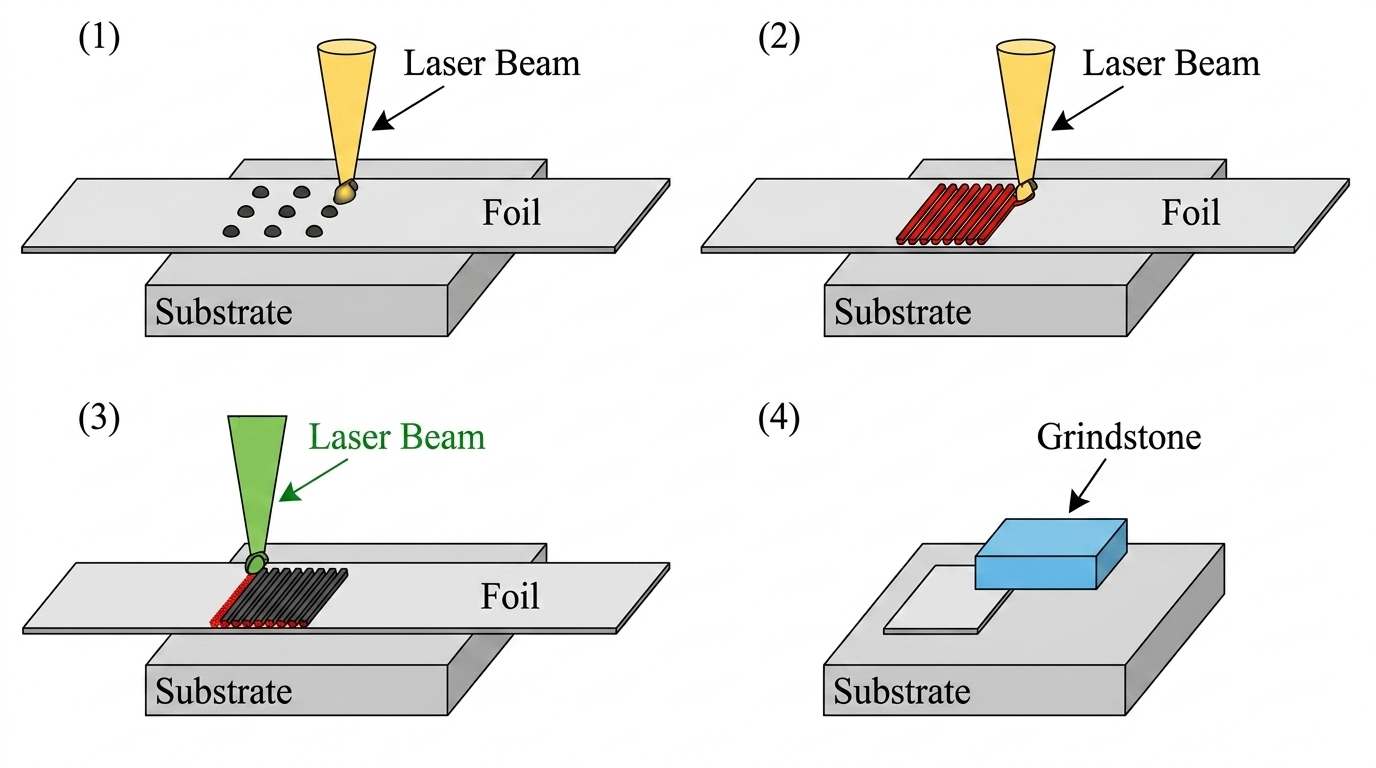
Researchers at Missouri University of Science and Technology have developed a Laser Foil Printing-based method for embedding wireless cavity resonator sensors inside metal structures. The approach combines Laser Foil Printing with
a Film-Cavity Resonator design. During fabrication, a thin cavity and waveguide are patterned into metallic foil, filled with ceramic material through a sol-gel coating process, and sealed as additional foil layers are printed. This creates a microscale resonator sensor enclosed within the metal structure, without internal wiring or surface-mounted components. The embedded sensor can wirelessly
monitor local strain and temperature by detecting shifts in resonant frequency.
Value Proposition
This technology enables smart metal structures with built-in passive wireless sensing capability. Because the sensor is embedded during fabrication, it is protected from surface damage and does not require internal wiring, batteries, or separate sensor housing. The metallic structure itself serves as part of the resonator/waveguide architecture, while the ceramic fill helps preserve local mechanical integrity. The approach is designed to minimize structural penalty while enabling internal monitoring of strain and temperature.
Potential applications include aerospace components, bridges, wind turbine structures, defense systems, pressure vessels, and other high-value metal structures where real-time structural health monitoring is critical.
Development Stage
Proof of concept demonstrated in the lab. Wireless sensing and sensor embedding validated.
Intellectual Property
Provisional Patent Application Filed
Follow Technology Transfer and Economic Development