
Case Number: 24MST023
Manager: Robert Prosak
Director, IP & Licensing
S&T Technology Transfer & Economic Development
robert.prosak@mst.edu
PDF Download: Locatable Plastic Methane Pipe to Reduce Excavation- Related Gas Explosions Marketing Slick
Publication: Locatable Plastic Methane Pipe to Reduce Excavation- Related Gas Explosions Publication
Opportunity
Seeking gas utility, pipe manufacturing, infrastructure, and safety partners to reduce excavation-related methane-pipe strikes.
Problem Statement
Natural gas distribution is increasingly dependent on plastic pipe because it is corrosion-resistant and practical to install. Unlike metal pipe, buried plastic pipe cannot be located directly with conventional electromagnetic pipe locators unless a tracer wire, marker tape, or records are accurate and intact. When plastic methane lines are missed, mismarked, or damaged during excavation, gas can migrate underground, enter buildings, and ignite. Recent gas explosions show that line strikes and poor utility location can destroy buildings, injure workers and residents, cause fatalities, interrupt service, and create major liability for utilities and contractors.
Solution
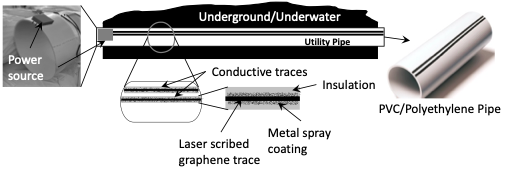
Researchers at the University of Missouri have developed a platform technology that integrates conductive structures directly into the walls of plastic pipes. For methane distribution pipes, these structures could enable the pipes themselves to emit or carry a detectable signal, making buried plastic gas lines easier to locate before excavation. The same pipe-integrated architecture may also support future leak detection, strain or damage monitoring, pressure and temperature sensing, and communication with utility asset-management systems.
Value Proposition
This technology addresses an immediate pain point for gas utilities: buried plastic methane pipes can be safer if the pipes themselves are locatable. A pipe-integrated signal path could reduce dependence on separate tracer wires and inaccurate records, improve excavation safety, reduce third-party damage, and support more reliable utility mapping. The first commercial case is clear: a smart methane pipe that helps prevent catastrophic line strikes. The wider opportunity is a new class of gas-distribution pipe that is locatable, monitorable, and ready for future intelligent infrastructure applications.
Development Stage
Validated in the laboratory.
Intellectual Property
Patent pending
Inventors
Jie Huang, Rex E. Gerald II, Abhishek Prakash Hungund , Bohong Zhang, Homayoon Soleimani Dinani, Ryan O’Malley, Kelsey Vancil, Michael Lee Davis II and Thomas M Spudich
Follow Technology Transfer and Economic Development