
Case Number: 20MST023
Manager: Robert Prosak
Director, IP & Licensing
S&T Technology Transfer & Economic Development
robert.prosak@mst.edu
PDF Download: Manufacture of alloys with controlled chemical compositions via chemical vapor transport annealing PDF
Publication: Manufacture of alloys with controlled chemical compositions via chemical vapor transport annealing Publication
Opportunity
Seeking a licensing and development partner to advance this process for producing shaped nickel titanium parts with controlled composition.
Problem Statement
Nickel titanium alloys can remember and recover their shape, but that behavior depends closely on composition. Making a part can change the balance of nickel and titanium. This is a particular concern when lasers are used to build custom parts. Manufacturers need a way to bring a shaped part to the intended composition without relying on precise timing.
Solution
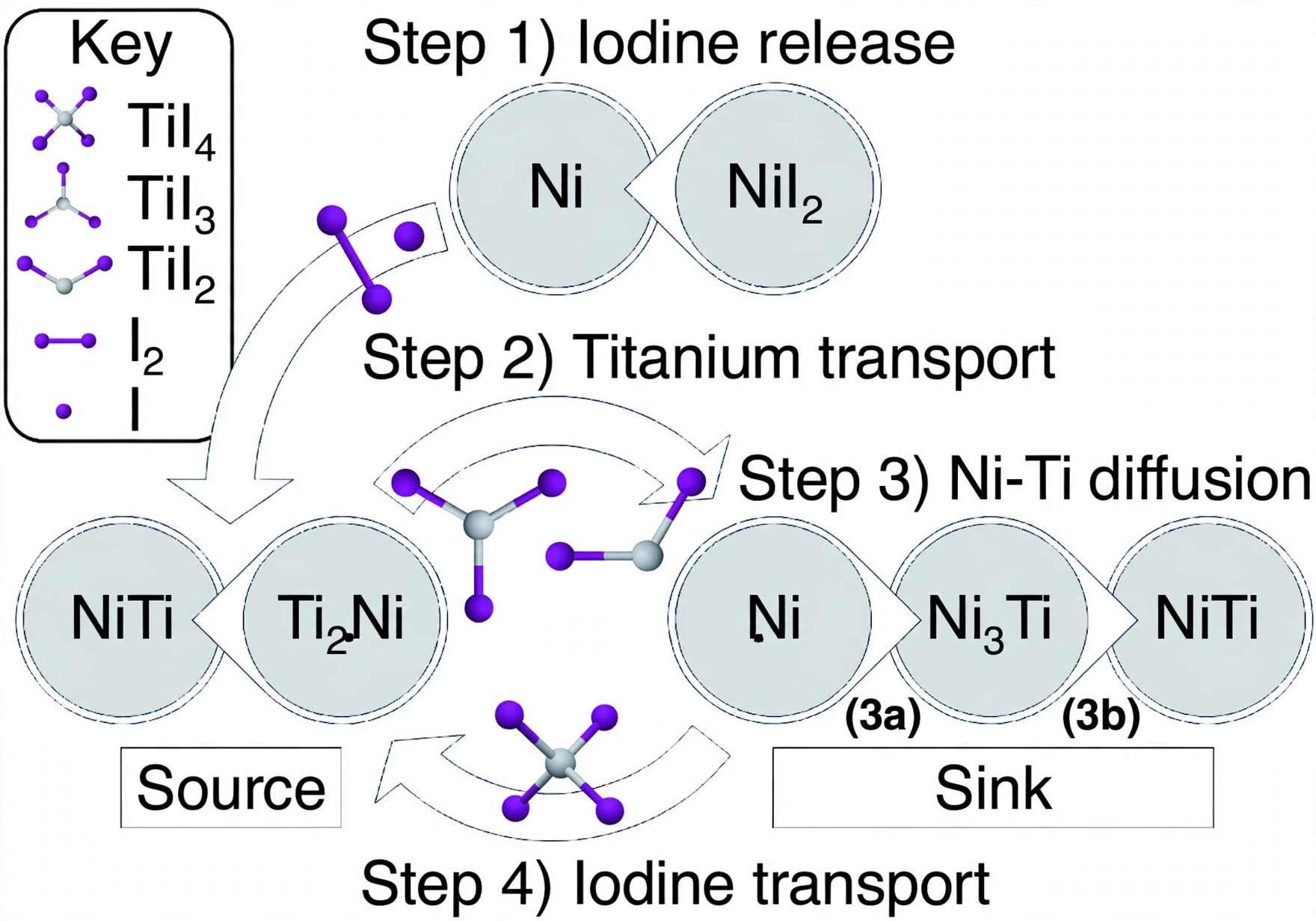
Researchers at Missouri University of Science and Technology have developed a heat treatment that moves titanium through a vapor into a shaped metal part. The key is the choice of titanium source. A mixture of two nickel titanium phases sets the point at which titanium stops moving into the part. The part can reach that point while retaining the shape of its starting template. In tests on nickel foam, the equilibrium process produced NiTi shape memory alloy whose composition and thermal-mechanical hysteresis were reproducible without needing to optimize heat treatment diffusion times. Extending treatment from four to eight hours produced no detectable further change.
Value Proposition
This process gives manufacturers a way to control composition after a part has been shaped. It could be useful for custom shape memory components whose composition changes during production as occurs, for example, during selective laser sintering / selective laser melting-based additive manufacturing. By allowing the treatment to reach equilibrium, it reduces the need to set a different treatment time for parts of varying thickness and geometry.. The nickel titanium foam produced in the reported tests showed a reversible phase transformation and a mechanical shape memory response.
Development Stage
Demonstrated in the lab on nickel foam.
Intellectual Property
U.S Patent Application Publication US 20230096442A 1
Inventors
David W. Lipke, Andrew S. King and Ryan D. Dempsey
Follow Technology Transfer and Economic Development