
Case Number: 16MST019
Manager: Robert Prosak
Director, IP & Licensing
S&T Technology Transfer & Economic Development
robert.prosak@mst.edu
PDF Download: Method And Apparatus For Fabricating Ceramic And Metal Components Marketing Slick
Publication: Method And Apparatus For Fabricating Ceramic And Metal Components Publication
Opportunity
Seeking a licensing and development partner to scale this additive manufacturing process into commercial production.
Problem Statement
Fabricating complex ceramic components using traditional manufacturing methods is very challenging, time-consuming, and costly. Additive manufacturing, or 3D printing, by the use of material extrusion offers a highly desirable alternative. However, many ceramic components fabricated by extrusion-based 3D printing, especially large parts with complex geometry, warp and even crack after sintering because of uneven drying of ceramic pastes during the extrusion fabrication process.
Solution
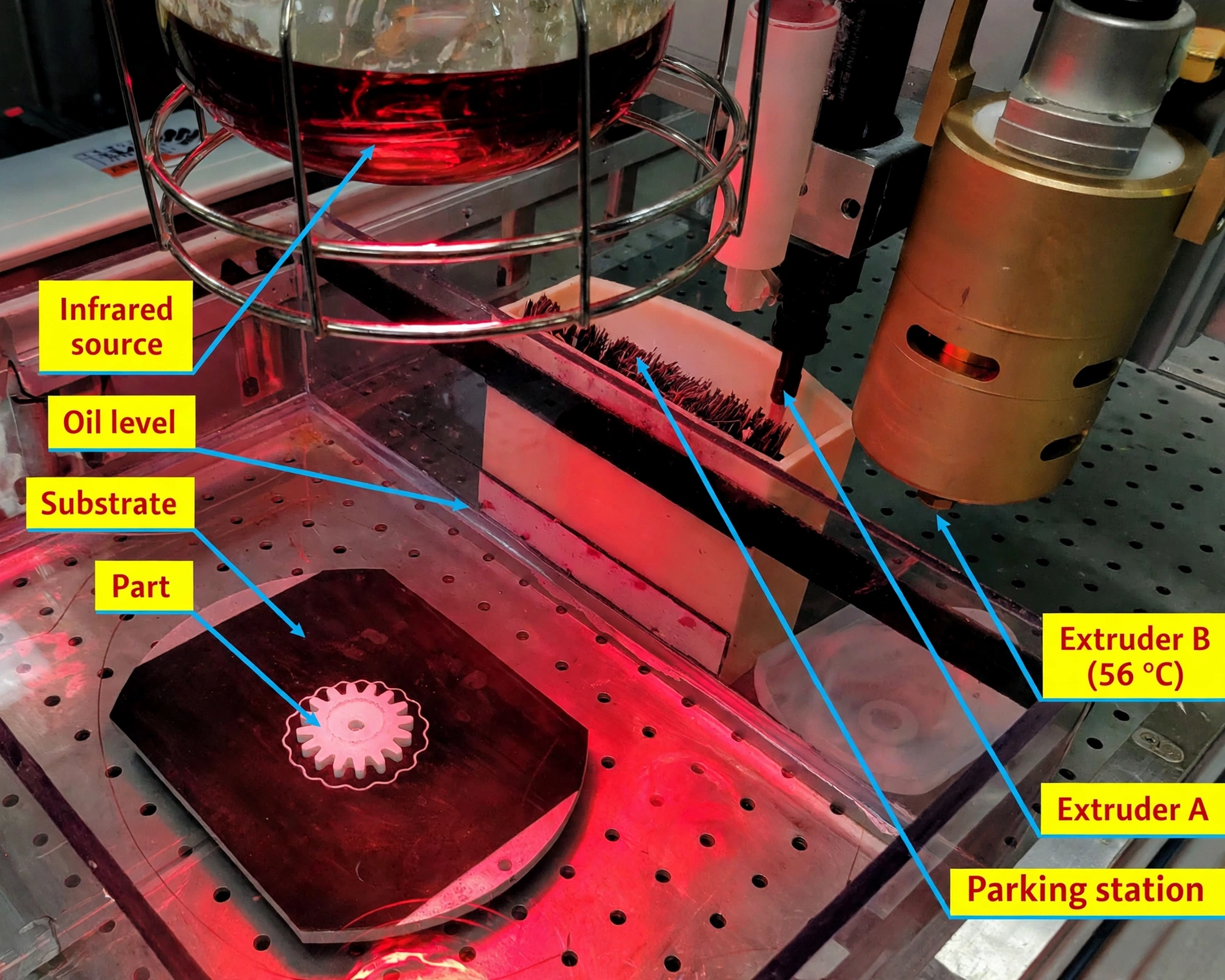
We have invented and developed a novel process, called Ceramic On-Demand Extrusion (CODE), for fabricating three-dimensional ceramic (and metal) parts with near-theoretical density by extrusion of aqueous ceramic pastes, with the final parts produced after debinding and sintering. In the CODE process, an aqueous ceramic paste with a very low binder content is extruded through a nozzle, which traverses along a computer-generated path from the desired part geometry, at room temperature. After the paste deposition for one or more layers, the layer(s) is surrounded by a light mineral oil just below the top surface of the fabricated section, after which infrared radiation is applied to uniformly dry the exposed surface of the newly deposited layer. Tis sequence is repeated until fabrication of the ceramic component is complete.
Value Proposition
The invented process enables controlled layer drying during the extrusion fabrication of parts with complex geometry. Fabrication of functionally graded parts can also be achieved through dynamic mixing of different ceramic pastes supplied by multiple cylinders and coordinated control of their volumetric flowrates. Sample parts that have been demonstrated using this fabrication process include gears, turbine impellars, impellar housings, ceramic ornaments, thin-wall shells, rocket nose cones, etc. in alumina and zirconia.
Development Stage
Validated in the lab. Demonstrated on multiple complex parts including a sintered gear, an impeller, sensor embedded refractory blocks, and a prosthetic hip joint prototype in alumina and zirconia.
Intellectual Property
Granted US Patent No. 10,259,158
Inventors
Ming C. Leu, PhD., Amir Ghazanfari, PhD., Wenbin Li, PhD., Gregory E. Hilmas, PhD., and Robert G. Landers, PhD.
Follow Technology Transfer and Economic Development