
Case Number: 21MST024
Manager: Robert Prosak
Director, IP & Licensing
S&T Technology Transfer & Economic Development
robert.prosak@mst.edu
PDF Download: Method for generating a reduced equivalent model of an electric power network for SCED and SCUC applications Marketing Slick
Publication: Method for generating a reduced equivalent model of an electric power network for SCED and SCUC applications Publication
Opportunity
Seeking a licensing and development partner to bring this technology into commercial power system operations and market simulation software.
Problem Statement
Security-constrained economic dispatch (SCED) and security-constrained unit commitment (SCUC) are backbone functions of power system operations. Running these programs on a full-scale grid model is extremely time-consuming. Running these programs on a full-scale grid model can take anywhere from half an hour to several days for a single scenario, while analyzing a number of selected scenarios
can require several weeks. Grid operators and market participants routinely need to analyze dozens or hundreds of scenarios in a short time window. Real grid data compounds the problem. Detailed real-world grid models and certain operational data may contain sensitive or protected critical energy infrastructure information and therefore often cannot be publicly shared, which limits researchers
and third parties from testing and validating new tools on real systems.
Solution
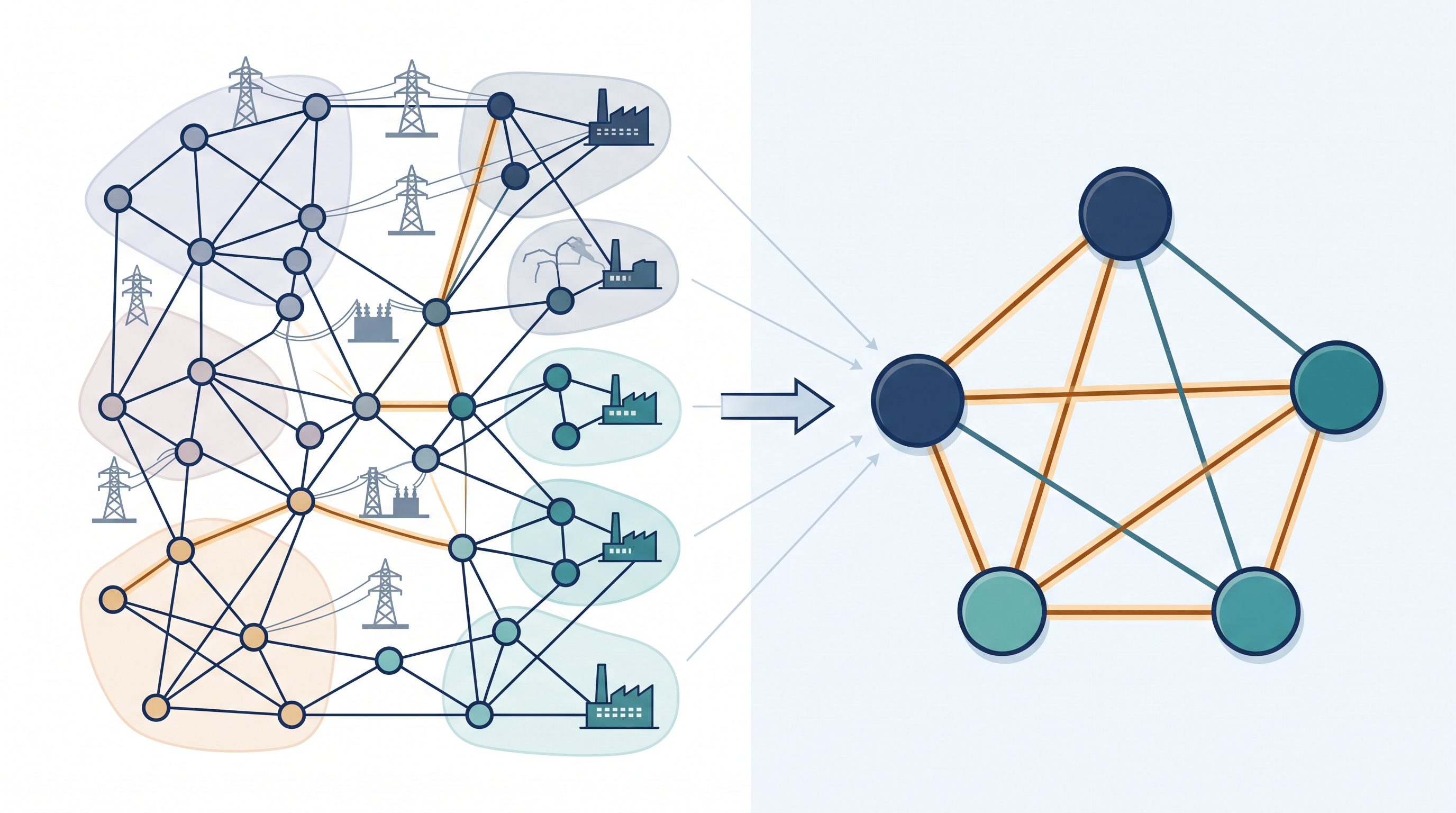
Researchers at Missouri University of Science and Technology have developed a method to generate a compact equivalent model of a large-scale power network built specifically for SCED and SCUC applications. The method takes actual power line flow data and network congestion data from a real grid and produces a much smaller model that behaves like the original. When SCED and SCUC programs run
on this reduced model, they deliver highly accurate outputs including power line electricity flow, network congestion, market clearing prices, and generation dispatch. The method accounts for multiple operating conditions when constructing the reduced network, helping it preserve relevant grid behavior across a range of system conditions. It also protects sensitive grid topology and parameter information, making the original system difficult to reverse-engineer from the reduced model.
Value Proposition
This technology cuts SCED and SCUC computation time from days or weeks down to minutes or hours. It also helps address the data confidentiality barrier that has long blocked power systems research by producing publicly shareable grid models built from real operational data. Because these models are derived from real measurements rather than synthetic data, practitioners will trust and use them. Unlike existing network reduction approaches, which can have significant limitations when applied to SCED and
SCUC, this technology was developed specifically to support SCED and SCUC applications.
Development Stage
Prototype developed and validated with real power grid data
Intellectual Property
Granted U.S. Patent No. 12,717,983
Inventors
Rui Bo, PhD
Follow Technology Transfer and Economic Development