
Case Number: 25MST002
Manager: Robert Prosak
Director, IP & Licensing
S&T Technology Transfer & Economic Development
robert.prosak@mst.edu
PDF Download:Microbial Fuel Cell Based Bioleaching PDF
Publication: Coming Soon
Opportunity
Seeking a licensing and development partner to advance this bioleaching system to industrial scale.
Problem Statement
Bioleaching already recovers about 20 percent of the world’s mined copper, but it carries real costs and risks. The most common method, heap bioleaching, operates as an open system that can leak acid and allow bacteria to escape into the environment. The process is also energy-heavy. Grinding the ore, inducing microcracks, agitating the bacterial inoculum, and aerating the system all contribute. There is a need for a cleaner and more energy-efficient way to recover metals from ore.
Solution
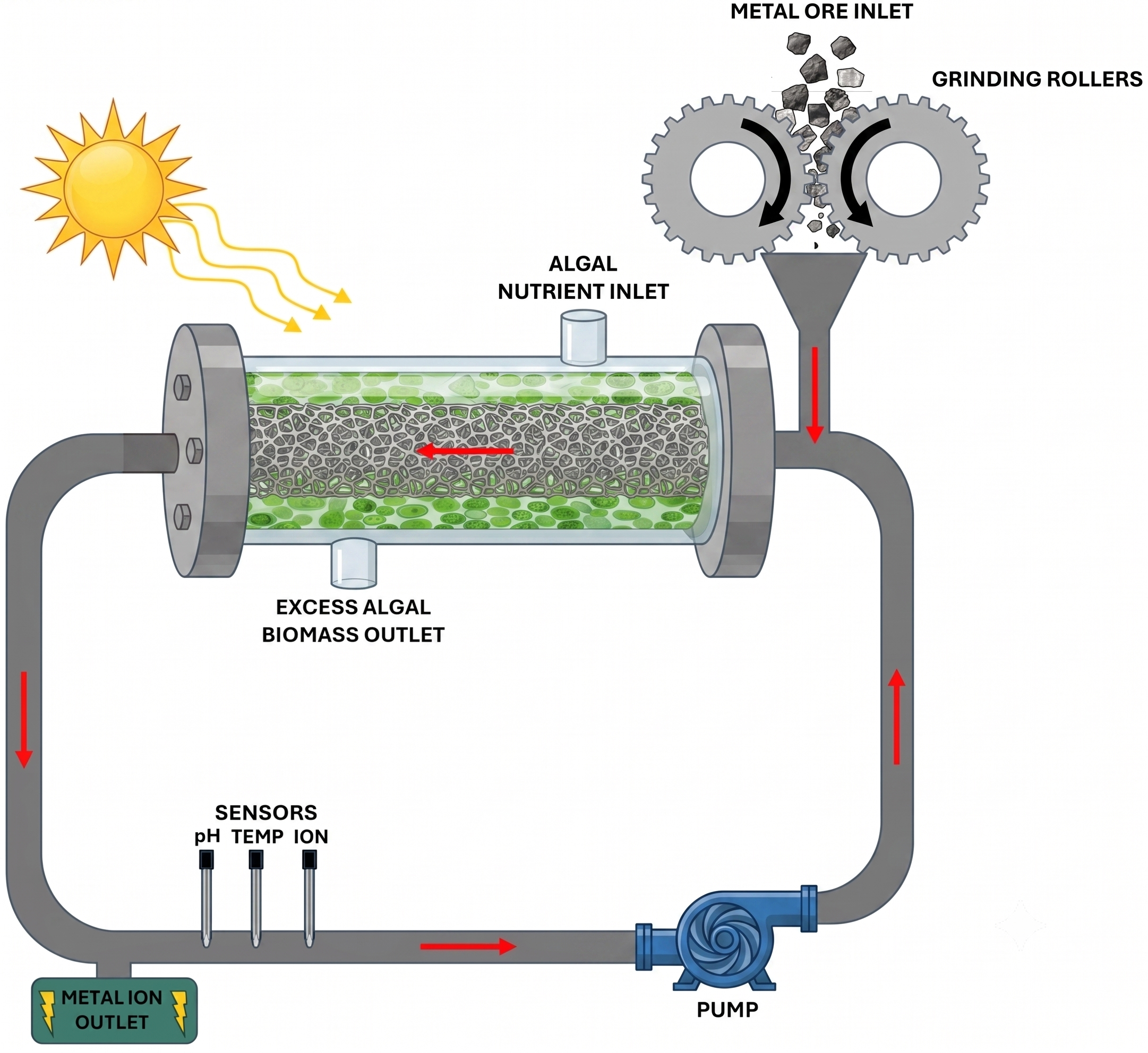
Researchers at Missouri University of Science and Technology have developed a closed-loop bioleaching system built around an algae-assisted microbial fuel cell. Bacteria break down the ore in an acidic medium and release electrons that are captured to generate electricity. That electricity offsets the energy the system uses. Acidophilic algae in the cathode chamber consume the CO2 produced by the bacteria and convert it into oxygen through photosynthesis. The algae eliminate the need for mechanical aeration, help maintain a stable pH, and produce water as a byproduct. Excess algal lipids can even be harvested as biofuel. The whole system is closed, batch-based, and modular, so it contains harsh chemicals, recycles water, and scales by adding units.
Value Proposition
This system turns the two biggest weaknesses of bioleaching into strengths. The microbial fuel cell pulls electrons off the bacteria, which both generates power and speeds up their metabolic activity for faster processing. The algae replace external aeration and lower the CO2 footprint at the same time. The closed-loop design cuts chemical waste, lowers water use, and removes the need for intensive wastewater treatment. The modular build keeps the footprint small and lets operators expand as needed.
Development Stage
Conceptual system design
Intellectual Property
Provisional Patent Application Status: Preparation
Inventors
Jonghyun Park, Eliana Stanislawski, Jacob Sutton and Kiernan O’Boyle
Follow Technology Transfer and Economic Development