
Case Number: 20MST036
Manager: Robert Prosak
Director, IP & Licensing
S&T Technology Transfer & Economic Development
robert.prosak@mst.edu
PDF Download: Miniature 3D Position-to-Optical Displacement Sensor Marketing Slick
Publication: Miniature 3D Position-to-Optical Displacement Sensor Publication
Opportunity
Seeking a licensing and development partner to bring this sensor into commercial production.
Problem Statement
Precise displacement measurement underpins many industries, from aerospace and robotics to structural health monitoring. The current standard is the Linear Variable Differential Transformer (LVDT), an electromechanical sensor used for decades in aircraft, nuclear power, servo mechanisms, and process control. LVDTs are reliable, but they are vulnerable to electromagnetic interference, and industry standards cap their accuracy, with the tightest published tolerance at +/-25 μm. A compact sensor is
needed that delivers finer resolution and withstands electrically noisy environments.
Solution
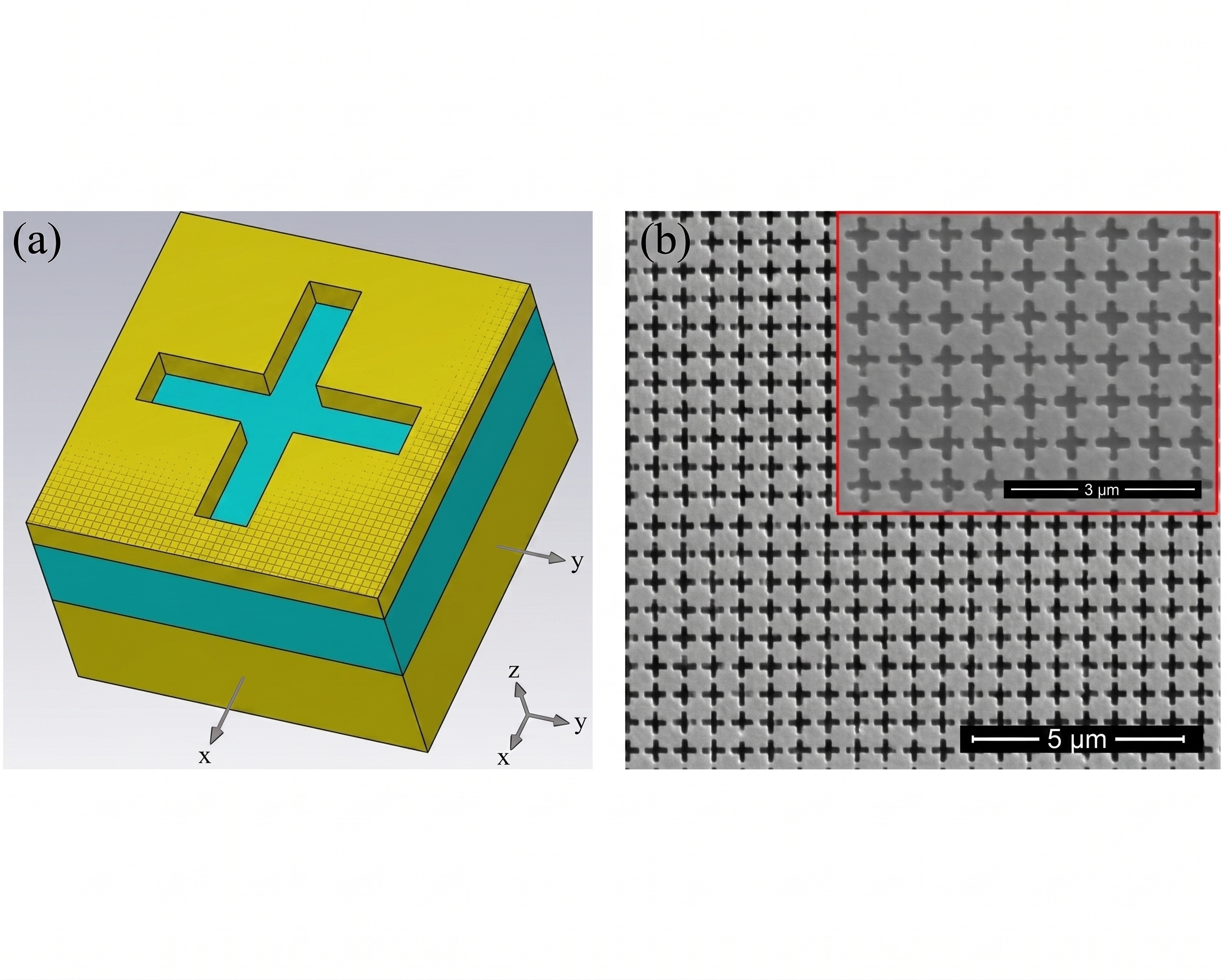
Researchers at Missouri University of Science and Technology have developed a miniature optical sensor that measures displacement in three dimensions with micrometer accuracy. It pairs a fiber optic interferometer with a series of gold-coated metasurface resonators patterned onto a mirror. As light travels through the fiber and reflects off the mirror, it creates an interference pattern that tracks movement along the Z axis. At the same time, the wavelength-selective resonators pinpoint movement along the X and Y axes. Three of these fibers can be bundled into a single tri-interferometer package
to capture rotational displacement, which is useful for monitoring debonding and delamination at material interfaces. In testing, the sensor measured three-dimensional displacement up to about 450 μm with a maximum error of about 5.4 μm (2.2%).
Value Proposition
The Link-bar FRP coupler finally provides GFRP rebar with a reliable mechanical splice where none existed before. Its corrosion resistance eliminates the risk of rust in metal couplers and reduces long-term maintenance costs. In tensile pull-out testing per ASTM D 7205 and D 7957, spliced bars reached an average ultimate tensile strength of 8,500 lb. The result is a durable and sustainable connection suited to tough environments.
Development Stage
Validated in the lab
Intellectual Property
Granted US Patent No. 12,025,438
Inventors
Genda Chen, PhD, Jie Gao, PhD and Chuanrui Guo, PhD
Follow Technology Transfer and Economic Development