
Case Number: 21MST028
Manager: Robert Prosak
Director, IP & Licensing
S&T Technology Transfer & Economic Development
robert.prosak@mst.edu
PDF Download: Mobile Robot Configured To Determine Human Arm Stiffness During Overground Interaction PDF
Publication: Mobile Robot Configured To Determine Human Arm Stiffness During Overground Interaction Publication
Opportunity
Seeking a licensing and development partner to bring this robot to market for rehabilitation, mobility assistance, manufacturing, and entertainment applications
Problem Statement
Robots that walk beside a person, such as PR-2, can move with the user but cannot measure arm stiffness and lack a natural, human-like feel. In contrast, robots that can measure arm stiffness, such as MIT-Manus and Kinarm, only work in a seated, stationary setting. Neither option can measure arm stiffness while a person is walking. A mobile robot is needed that can walk with a person and measure arm stiffness during that interaction.
Solution
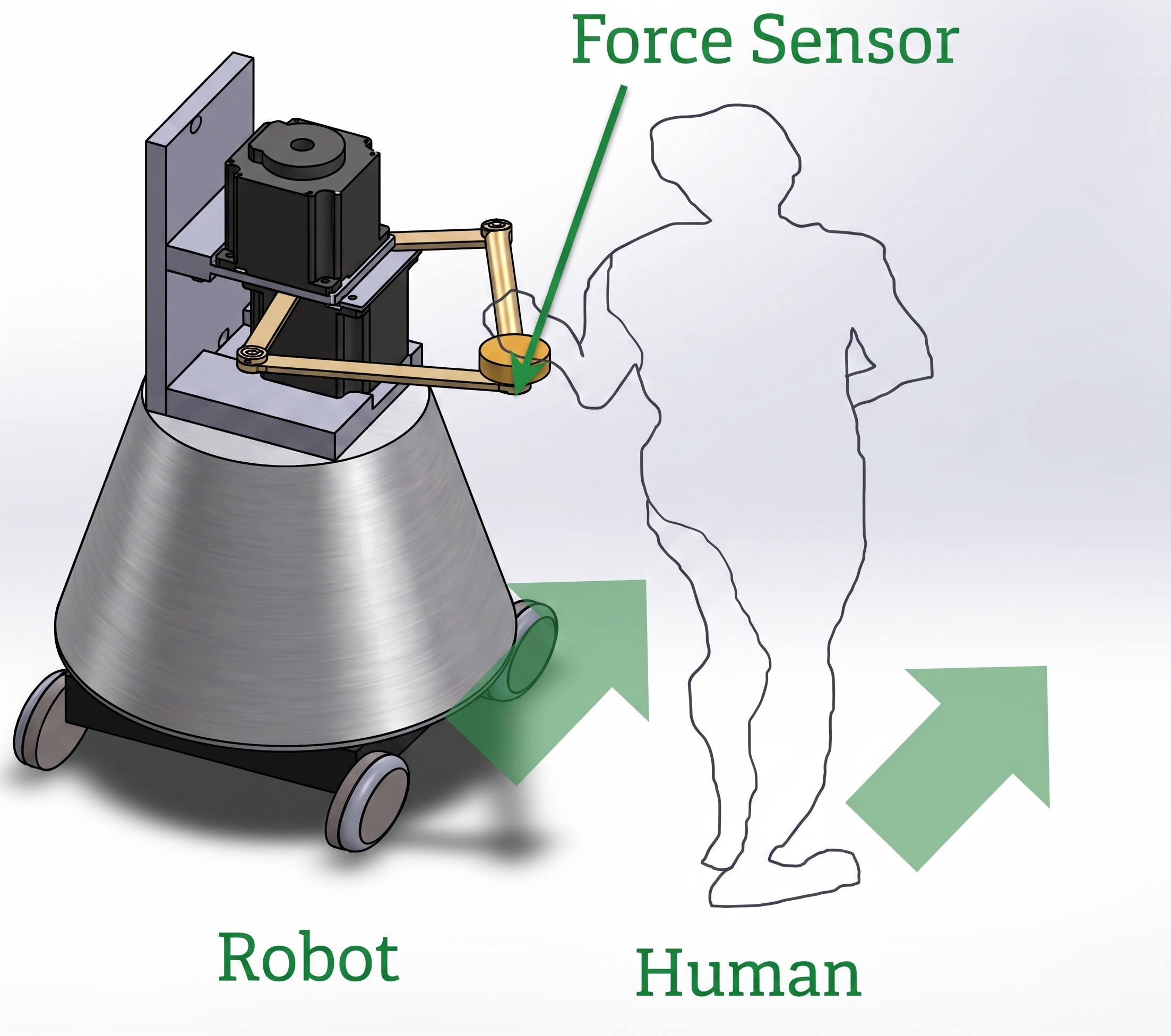
Researchers at Missouri University of Science and Technology developed a mobile robot that walks with a person and measures the stiffness of their arm during that walk. The robot has two parts. A low impedance robot arm lets the user hold a handle and exchange forces with the robot much like a human partner would. A mobile base carries the arm and adjusts its speed to match the user, allowing the robot to move naturally while measuring stiffness. Two brushless DC motors with no gearheads and a lightweight symmetric linkage give the arm very low inertia and friction for a natural feel. To measure stiffness, the robot applies a single gentle force pulse to the user’s hand and measures the arm’s response. This is the first robot able to make this measurement while a person is walking overground.
Value Proposition
This robot gives researchers and clinicians a practical way to study how a person’s arm stiffens and relaxes while walking with a robot, advancing rehabilitation assessment. By using a single force pulse instead of a continuous series of perturbations, it makes measurement faster and easier than older methods. This capability supports the development of more responsive robots for rehabilitation and physical therapy, mobility assistance, manufacturing, and entertainment.
Development Stage
Full prototype built.
Intellectual Property
Granted US Patent No 12,246,435
Inventors
Sambad Regmi, PhD and Yun Seong Song, PhD
Follow Technology Transfer and Economic Development