
Case Number: 25MST025
Manager: Robert Prosak
Director, IP & Licensing
S&T Technology Transfer & Economic Development
robert.prosak@mst.edu
PDF Download:Module-Based Flow Battery with Heat-Exchanger Design Marketing Slick
Publication: Coming Soon
Opportunity
Seeking a licensing and development partner to scale into manufacturing.
Problem Statement
Redox flow batteries have genuine potential for grid-scale energy storage, but the conventional stacked design has held the technology back. Flat membranes degrade under mechanical stress. Electrolyte leakage is a persistent reliability problem. Installation is rigid and costly. And the dominant chemistry relies on vanadium, a scarce and price-volatile material. The industry needs a flow battery that is cheaper to build, easier to install, and simpler to scale.
Solution
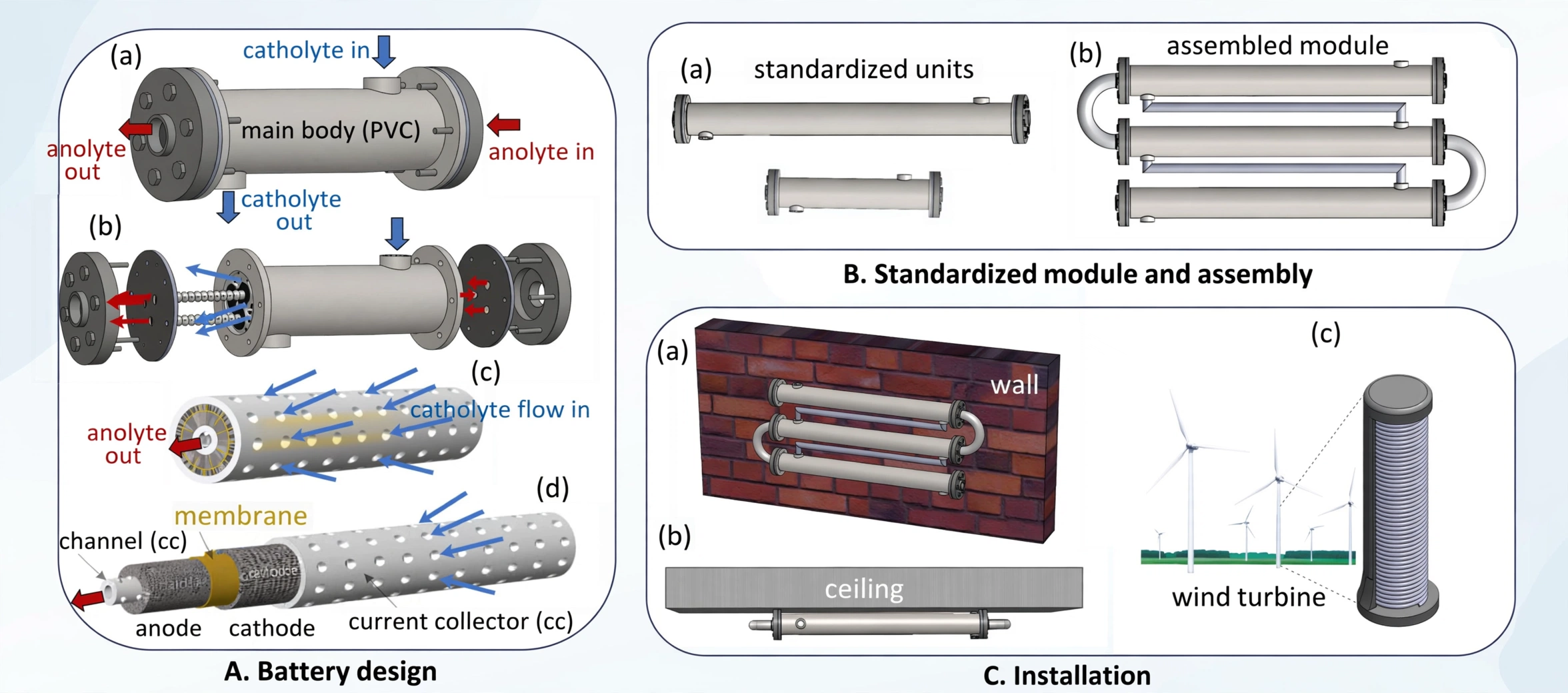
Researchers At Missouri University of Science and Technology have invented a flow battery called Redox Exchange Flow Battery (REFB). It represents a new approach to flow battery design. Unlike other batteries that use stacked plates, the REFB uses an architecture inspired by heat exchangers, where anolyte and catholyte are channeled into separate concentric tubes in one PVC cell. An SPEEK membrane created using sulfonation technique separates the flows, making it leak-proof while ensuring better contact between electrodes. The REFB utilizes inexpensive iron-based coordination compound electrolytes working at nearly neutral pH. This eliminates the need for expensive and corrosive vanadium electrolytes that are required in other designs.
Value Proposition
The REFB offers an advantage in manufacturing simplicity and lower costs. It has a modular design that makes it easy to implement in utility applications. Instead of rare vanadium, iron-based electrolytes use one of the most abundant elements in the earth. The tube structure allows installation possibilities not possible for flat plate batteries. The global market for flow batteries is expected to reach $805 million by 2028, growing at a CAGR of 22.8%.
Development Stage
Prototype fabricated and demonstrated in the lab.
Intellectual Property
Provisional Patent Application Status: Filed
Follow Technology Transfer and Economic Development