
Case Number: 25MST028
Manager: Robert Prosak
Director, IP & Licensing
S&T Technology Transfer & Economic Development
robert.prosak@mst.edu
PDF Download: Next-Gen Microbattery Manufacturing: Thick Electrodes and Binder-Free Design
Publication Download: Next-Gen Microbattery Manufacturing: Thick Electrodes and Binder-Free Design
Opportunity
Seeking a licensing and development partner to optimize processing parameters and scale toward commercial battery manufacturing.
Problem Statement
The miniaturized electronics inside today’s medical implants, MEMS devices, compact sensors, and autonomous microdevices are increasingly limited by battery size and runtime rather than by computing capability. Conventional lithium-ion microbatteries rely on stacked thin electrode layers, typically below 100 μm, which add manufacturing complexity and inactive material without fully addressing the need for higher energy density in a limited footprint. The field needs a scalable manufacturing approach that increases electrode thickness and areal capacity while maintaining effective ion and electron transport in compact battery architectures.
Solution
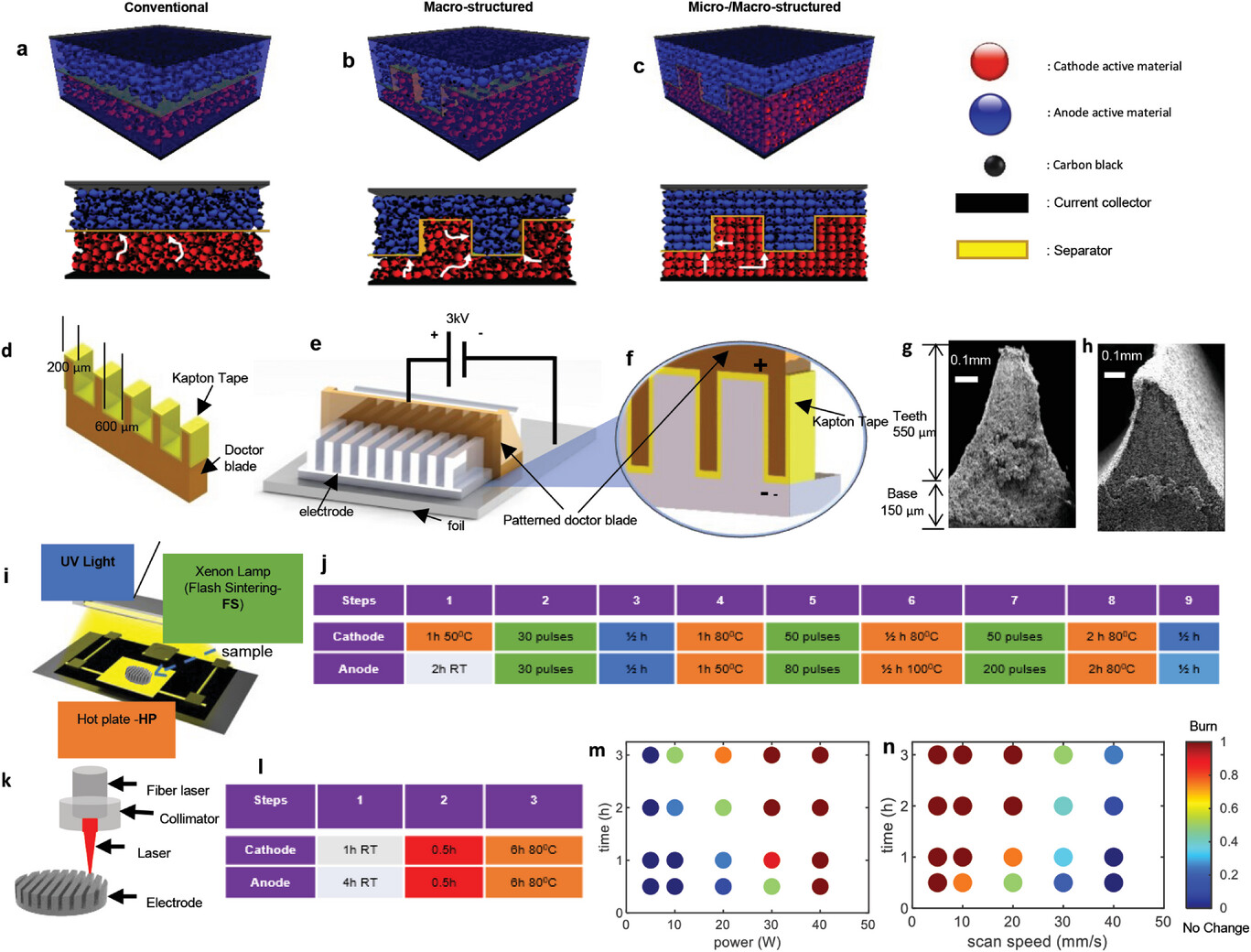
Researchers at Missouri University of Science and Technology have developed an ultra-thick electrode manufacturing approach for next-generation microbatteries. The technology enables single-layer electrodes up to 900 μm thick, nearly ten times the conventional thickness limit, by combining laser-etched current collectors, electric-field-assisted casting, precision thickness control, and ultrafast
laser structuring. This integrated process creates transport pathways within thick electrodes, reduces the need for repeated thin-layer stacking, and shortens the effective distance between anode and cathode in compact cell designs. Full-cell electrochemical performance has been demonstrated in laboratory testing, with stable discharge capacity confirmed across multiple cycles.
Value Proposition
This technology provides a manufacturing pathway for high-energy-density microbatteries by increasing active material loading within a compact footprint while reducing the complexity associated with multilayer electrode stacking. The approach is designed to improve areal capacity, simplify microbattery architecture, and preserve ion transport through laser-structured pathways in ultra-thick electrodes. Target markets include biomedical implants, MEMS devices, compact sensors, autonomous microdevices, and other applications where battery runtime and device size are in direct tension.
Development Stage
Validated in the lab.
Intellectual Property
Provisional Patent Application Status: Filed
Inventors
Jonghyun Park, Gracie Boyer and Jacob Sutton
Follow Technology Transfer and Economic Development