
Case Number: 25MST006
Manager: Robert Prosak
Director, IP & Licensing
S&T Technology Transfer & Economic Development
robert.prosak@mst.edu
PDF Download: Novel Methods for Transdermal Drug Delivery Marketing Slick
Publication: Coming Soon
Opportunity
Seeking a licensing and development partner to advance a stimuli responsive hydrogel platform for localized, on demand drug delivery through the skin, with initial applications in wound care, pain and inflammation management, infection control, and dermatology.
Problem Statement
Many therapeutics are delivered orally or by injection, even when treatment is needed at a specific tissue site. Oral delivery must pass through the gastrointestinal tract and liver, which can reduce bioavailability and expose the whole body to the drug. Injection is invasive and can carry risks to the liver. Transdermal delivery avoids these issues, but conventional patches release drugs passively at a fixed rate and cannot adjust to changing clinical needs. A wearable platform that releases drugs locally and on demand, with control over timing and dose, is needed.
Solution
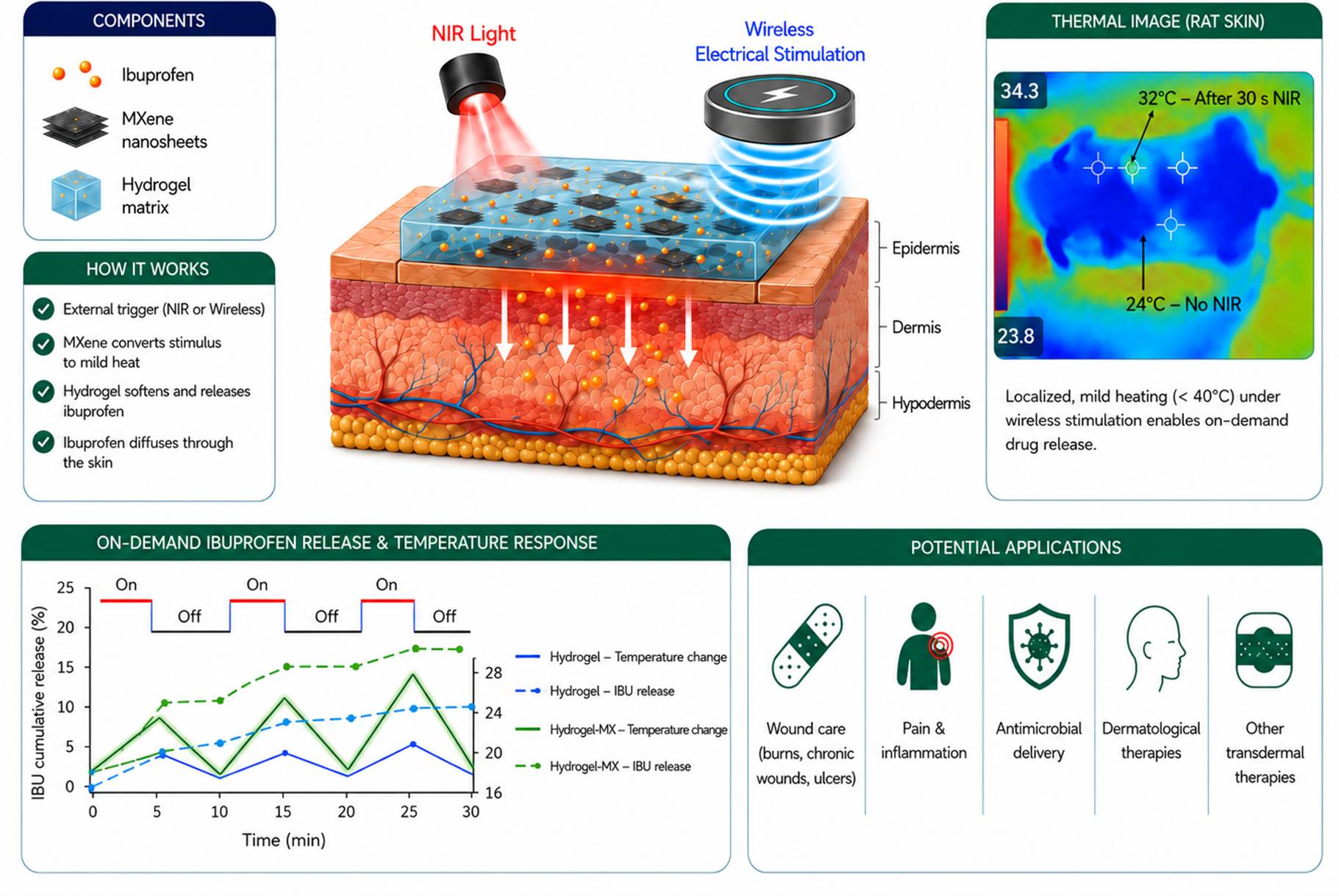
Researchers at Missouri University of Science and Technology developed a stimuliresponsive hydrogel patch reinforced with titanium carbide MXene nanoflakes for controlled transdermal drug delivery, using ibuprofen as a model therapeutic agent. When exposed to near-infrared light or a mild electrical stimulus such as a wireless charger, the MXene converts the input into localized, controlled heating. This change in the hydrogel promotes on-demand drug release and supports transport through the skin at the treatment site. The platform can accommodate different hydrogel formulations and drug payloads, operate within a safe temperature range, and be fabricated in customizable geometries for use in wearable patches or wound dressings.
Value Proposition
This technology pairs a drug-loaded hydrogel with a stimulus-responsive nanomaterial, enabling clinicians and patients to control when and where a drug is released. Unlike passive patches that continuously release a fixed dose, this platform delivers the drug only when triggered, potentially reducing unnecessary systemic exposure while maintaining the therapeutic agent at the treatment site. The design can be tuned to other drugs and geometries, offering a flexible path toward noninvasive, on-demand transdermal therapy.
Development Stage
Evaluated in vitro using human dermal fibroblasts and in vivo in a rat model. NIR triggered release tested with ibuprofen as a model drug.
Intellectual Property
Provisional Patent Status: Filed
Inventors
Fateme Fayyazbakhsh, Ming C. Leu, Vadym Mochalin, Yue-Wern Huang and Lev Suliandziga
Follow Technology Transfer and Economic Development