
Case Number: 25MST007
Manager: Robert Prosak
Director, IP & Licensing
S&T Technology Transfer & Economic Development
robert.prosak@mst.edu
PDF Download: Platform and Method for Wearable Therapeutic Warming Pads Marketing Slick
Publication: Coming Soon
Opportunity
Seeking a licensing and development partner to advance the technology toward manufacturing and commercialization in therapeutic warming and cold injury treatment.
Problem Statement
Frostbite and hypothermia require immediate and controlled rewarming to prevent tissue damage and amputations. Current warming solutions are all inadequate in the field and emergency settings. Disposable chemical heat packs can’t be controlled for temperature or duration. Traditional electric heating pads are heavy and need a wall outlet. Rigid medical rewarming devices are not portable and
distribute heat inconsistently. There is no lightweight wearable pad that delivers precise, programmable heat safely in remote and battlefield environments.
Solution
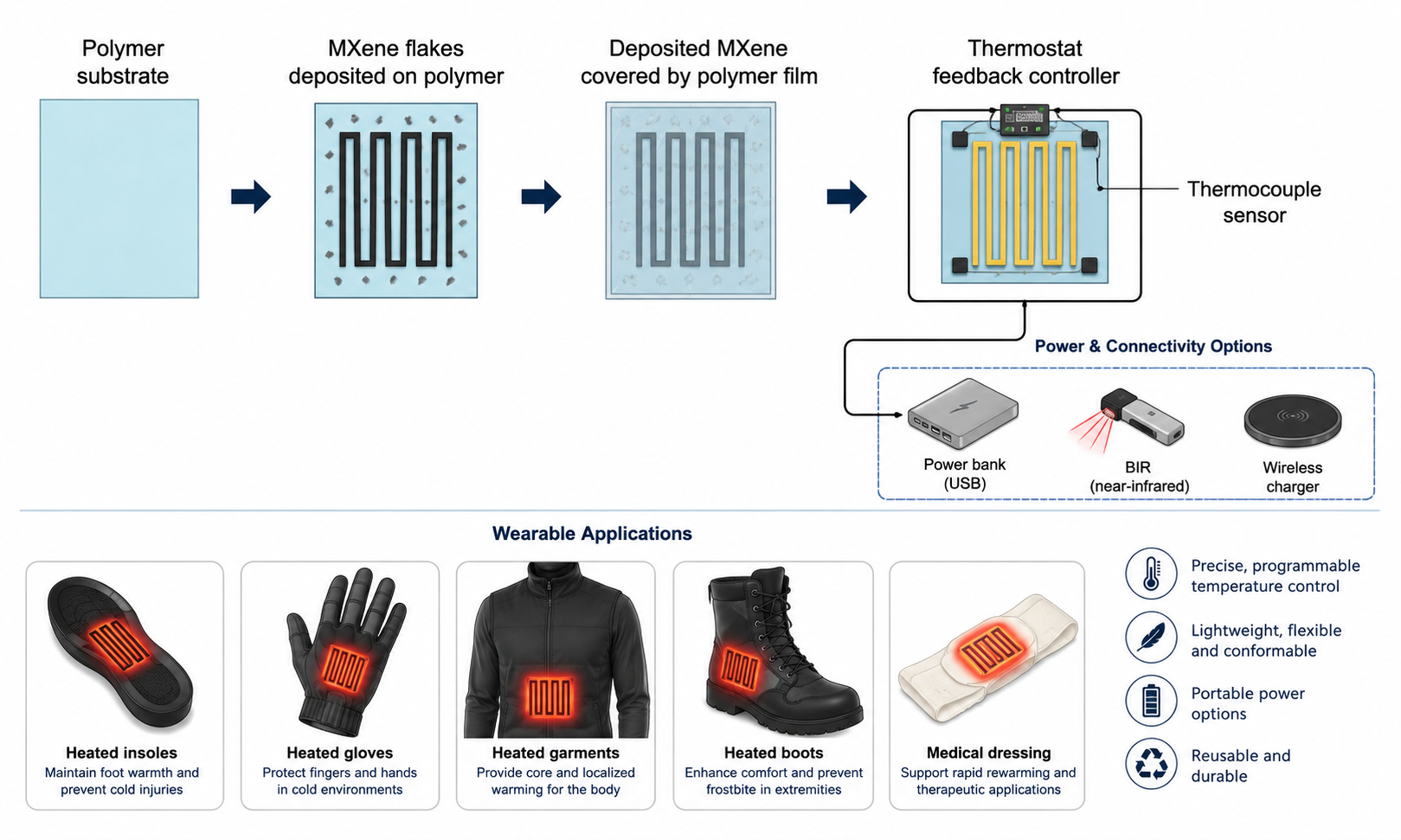
Researchers at Missouri University of Science and Technology have developed a flexible wearable warming pad based on a thin flexible polymer substrate layer coated with MXene titanium carbide. MXene converts electrical current into heat almost instantly through Joule heating and returns to room temperature within seconds when power is removed. In preliminary testing, a pad with 300 mg of
3D-printed MXene on polyurethane reached 40°C within five minutes at 12V. An onboard microcontroller with thermal sensors regulates heat in real time, and the pad can be preprogrammed for clinical protocols such as holding tissue at 37±3°C then stepping down to 15±3°C to prevent refreezing. The MXene layer is only 10-200 μm thick, making the pad fully flexible and conformable to the body. It runs on a standard 5V or 12V battery pack or USB power bank and can also be activated by NIR light.
Value Proposition
This pad is lightweight, reusable, programmable, and powered by standard portable batteries, making it practical for home care, clinical settings, wilderness rescue, and battlefield medicine. It can be integrated directly into wearable PPE, such as gloves, boots, and garments, to prevent cold injury. The same platform also supports transdermal drug delivery and wound healing applications, extending its commercial reach beyond warming alone.
Development Stage
Validated in the lab.
Intellectual Property
Provisional Patent Status: Filed
Inventors
Fateme Fayyazbakhsh, Ming C. Leu and Vadym Mochalin
Follow Technology Transfer and Economic Development