
Case Number: 25MST037
Manager: Robert Prosak
Director, IP & Licensing
S&T Technology Transfer & Economic Development
robert.prosak@mst.edu
PDF Download: Portable High-Resolution Fiber-Optic Raman Probe for Monitoring of Sulfate Attack in Concrete
Publication: Portable High-Resolution Fiber-Optic Raman Probe for Monitoring of Sulfate Attack in Concrete
Opportunity
Seeking a licensing and development partner to refine the design and scale the coupler toward manufacturing.
Problem Statement
Sulfate attack is one of the leading causes of concrete deterioration worldwide. Assessing it today means cutting core samples and sending them to a lab for analysis. Existing non-destructive methods detect physical cracks but miss chemical changes that occur well before any visible damage appears. There is no practical field tool for tracking sulfate ingress at the microscale without destroying the structure being assessed.
Solution
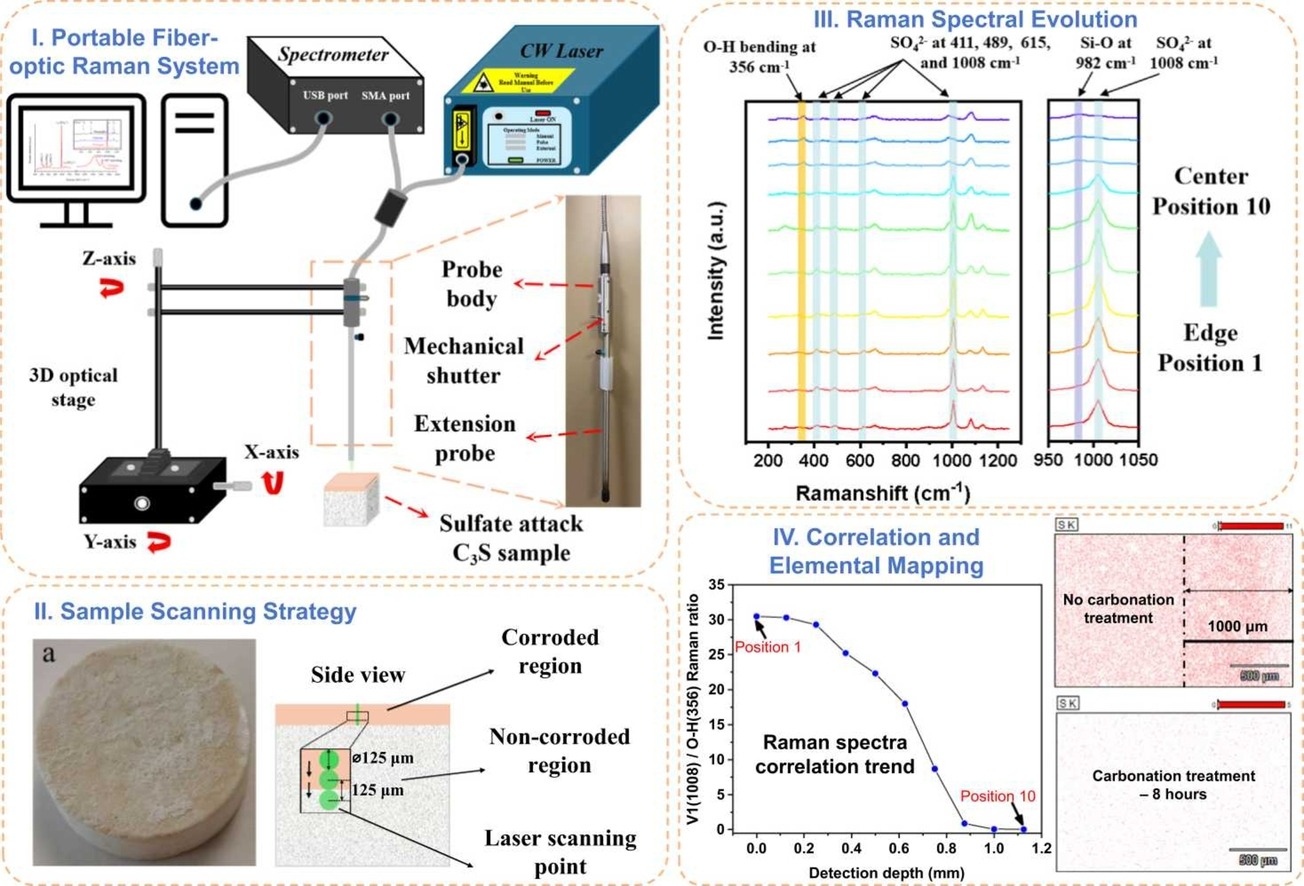
Researchers at Missouri University of Science and Technology have developed a portable fiber-optic Raman probe system capable of mapping the penetration depth of sulfate in cement paste with 125 μm spatial resolution. The probe delivers a 532 nm laser to the sample surface through a compact handheld assembly and collects the Raman signal through the same fiber path. By measuring the ratio of sulfate vibrational peaks to the hydroxyl bending mode at 356 cm-¹ at each scan position, the probe produces a precise chemical depth profile of sulfate ingress without destroying the sample. In specimens without protective treatment, the probe confirmed that sulfate penetration reached 1.0-1.2 mm after seven months of exposure. In specimens treated with the surface carbonation for 8 hours, sulfate-related peaks were completely absent throughout the scan. These results have been independently verified by SEM-EDS sulfur mapping and XRD phase analysis. The same probe was also used to characterize the protective CaCO3 layer formed by carbonation treatment, showing how a dense 30 m surface layer completely shuts down ion diffusion.
Value Proposition
The probe replaces destructive core sampling with a handheld scan. It gives engineers real-time chemical confirmation of the depth of sulfate ingress and the performance of protective treatment directly on site. The compact design is
suited for deployment on bridges, tunnels, foundations, and marine structures.
Development Stage
Validated in the lab and demonstrated in a live foundry dip test.
Intellectual Property
Provisional Patent Application Filed
Inventors
Bohong Zhang, Jie Huang, Hongyan Ma and Gao Deng
Follow Technology Transfer and Economic Development