
Case Number: 25MST036
Manager: Robert Prosak
Director, IP & Licensing
S&T Technology Transfer & Economic Development
robert.prosak@mst.edu
PDF Download: Real-Time High-Temperature Immersion Marketing Slick
Publication: Real-Time High-Temperature Immersion Publication
Opportunity
Seeking a licensing and development partner to advance the technology toward industrial deployment in steel manufacturing and related high-temperature processing industries.
Problem Statement
In steelmaking, the chemical composition of molten slag and flux directly affects product quality. Yet the standard way to measure it is to ladle out a sample, quench it rapidly, and send it to a lab. That process can take minutes to hours and alter the chemistry during cooling. More advanced real-time methods exist, such as high-temperature XRD and FTIR, but none of them allow a sensor to be physically submerged in a 1600 °C melt for direct in situ measurement. The result is that steelmakers are largely
working in the dark during one of the most critical stages of production.
Solution
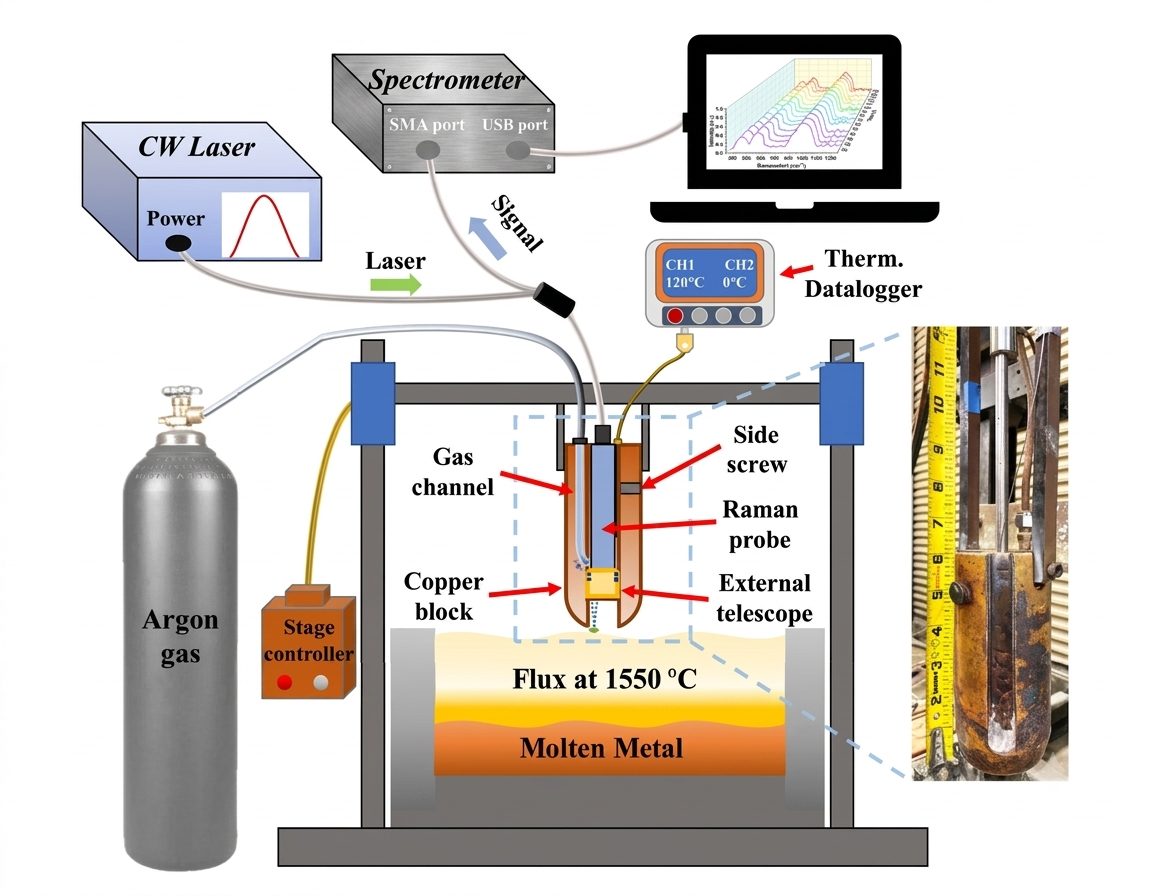
Researchers at the Missouri University of Science and Technology have developed an immersible fiber-optic Raman probe system capable of direct immersion into molten materials at temperatures above 1500 °C. The system houses a fiber-optic Raman probe within a thermally protective copper block. An extended-focal-length telescope inside the assembly delivers laser excitation to the melt surface through an open optical port. Argon gas flows continuously through a channel in the copper block to keep the port clear of molten material. The copper block itself dissipates heat so effectively that the probe tip stayed below 120 °C while immersed in a 1550 °C furnace. The system successfully captured real-time Raman spectra of molten slag during both laboratory induction-coil tests and live foundry dip tests. From those spectra, the team identified aluminum-oxygen, silicon-oxygen, and silicate network structural
features and used them to predict melt viscosity with strong linear correlation.
Value Proposition
This system provides operators with real-time chemical and structural information from within the melt without quenching a sample or waiting for a lab. Viscosity and composition can be tracked in real time and directly tied to process adjustments. The technology is applicable to steel ladle and tundish monitoring, glass production, molten salt reactors, and other high-temperature manufacturing processes. It opens the door to a new class of inline process sensors for industries where direct melt measurement has never been practical.
Development Stage
Validated in the lab and demonstrated in a live foundry dip test.
Intellectual Property
Provisional Patent Application Filed
Inventors
Bohong Zhang, Ronald O’Malley, Jie Huang and Hanok Tekle
Follow Technology Transfer and Economic Development