
Case Number: 26MST003
Manager: Robert Prosak
Director, IP & Licensing
S&T Technology Transfer & Economic Development
robert.prosak@mst.edu
PDF Download: Reassociating preformed particle gels for conformance control Marketing Slick
Publication: Coming Soon
Opportunity
Seeking a licensing and development partner to advance this technology from lab scale validation toward field trials and commercial deployment.
Problem Statement
Conformance control gels plug high-permeability zones in oil and gas reservoirs, redirecting fluids toward unswept oil. Most gels rely on metal additives, such as chromium, zirconium, or aluminum, to reassociate once placed downhole. These crosslinkers have been restricted in many regions because of their environmental toxicity. Polyethyleneimine is a common substitute but is highly toxic to aquatic life. Chitosan is a lower-toxicity option, but it has limited water solubility and precipitates at pH levels common in reservoir formations. A gel is needed that reassociates reliably without metal ions or added crosslinking agents and performs consistently across a wide range of temperatures and salinities.
Solution
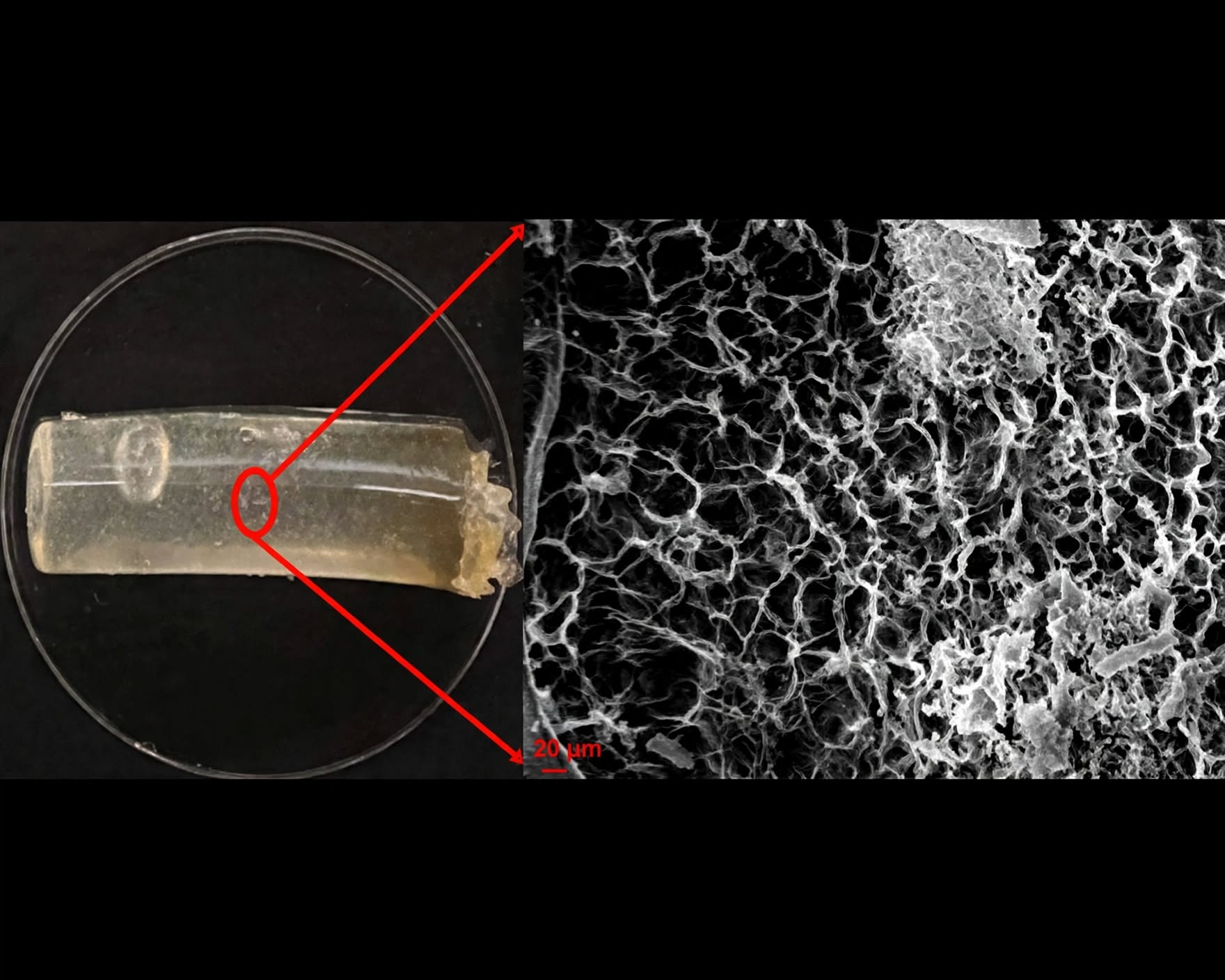
Researchers at Missouri University of Science and Technology have developed a self-healing polymer matrix that reforms into a bulk gel on its own, without metal ions or other reassembling agents added downhole. The matrix combines a nitrogen-containing comonomer that drives reassociation, a nonionic comonomer, and a small amount of water-soluble crosslinker. The comonomer copolymerizes with other common gel monomers at reactivity ratio near 1 for incorporation into random copolymer primary structures. Particles made from the matrix are injected into the formation, where they swell in reservoir fluid and reassociate into a bulk gel through physical entanglement rather than an additional chemical reaction. The same matrix can also be formed into a self-healing membrane that repairs itself on demand in systems such as batteries and fuel cells.
Value Proposition
This technology eliminates the need for metal ions and other downhole reassembling agents, reducing a major source of toxicity risk in reservoir treatments. In laboratory testing, the gel maintained its strength across a wide range of temperatures and salinities and remained stable for months in high-temperature, high-salinity brines. Because the particles reform into a gel through physical entanglement rather than a chemical reaction, no separate agents need to be mixed in the field. The result is a gel system that is simpler to handle and safer for the environment, with consistent performance across a wide range of reservoir conditions.
Development Stage
Validated in the lab.
Intellectual Property
Non-Provisional Patent Application Filed
Inventors
A. M. Yugandhara Y. Eriyagama, PhD candidate, Thomas P. Schuman, PhD and Baojun Bai, PhD
Follow Technology Transfer and Economic Development