
Case Number: 25MST032
Manager: Robert Prosak
Director, IP & Licensing
S&T Technology Transfer & Economic Development
robert.prosak@mst.edu
PDF Download: Robot Swarm Enabling Aerial Nondestructive Testing and Sensor Interfacing Marketing Slick
Publication: Coming Soon
Opportunity
Seeking a licensing and development partner to advance the system toward commercial deployment for infrastructure inspection.
Problem Statement
Bridges and other infrastructure must be inspected often to catch damage before it leads to failure. Traditional inspection is expensive, slow, and risky. It may require scaffolding or platforms, close traffic lanes for hours or days, and put inspectors in danger. Visual inspection by hand is also subjective and inconsistent. Newer tools help but fall short. Aerial drones can cover wide areas, but they cannot touch a surface to measure crack depth or plate thickness. Robotic crawlers can take tactile measurements, but they are built for flat surfaces and struggle to reach elevated or complex metal structures. No single tool can both fly to a hard-to-reach spot and inspect it precisely and efficiently.
Solution
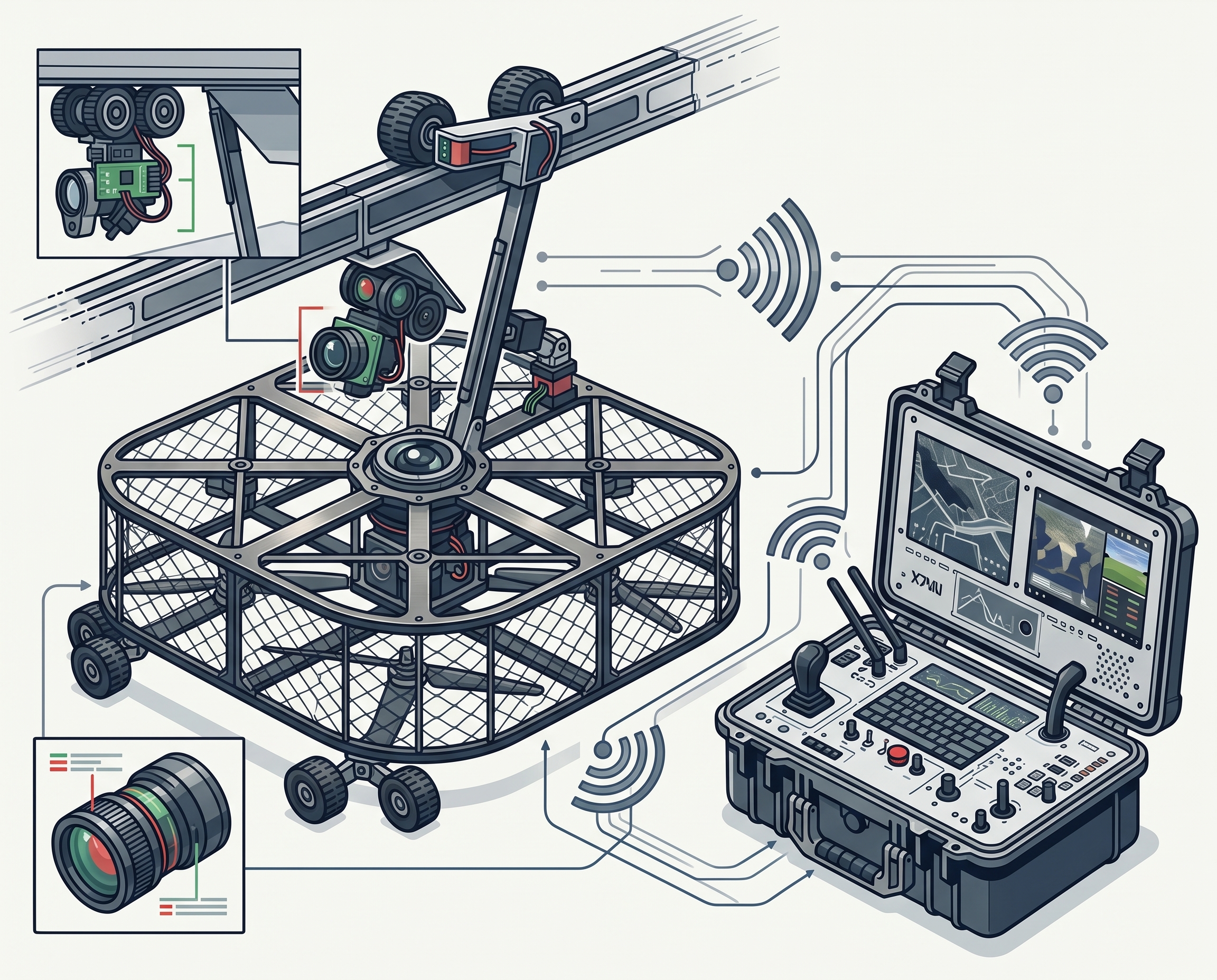
Researchers at Missouri University of Science and Technology have developed a hybrid unmanned vehicle that combines a drone with a detachable, magnetically wheeled crawler. The drone flies to a hard-to-reach area and lands on the structure. It then deploys a compact, palm-sized crawler that grips metal surfaces with four magnetic wheels. The crawler navigates vertical and inclined surfaces and moves around bolts, nuts, thin edges, and corners that larger systems cannot reach. It carries interchangeable inspection payloads, including a microscope with up to 1000x magnification for fine cracks and a crack-depth probe mounted on a haptic arm. The system switches between flight and surface modes on command and can shut down the flight system while crawling to save power.
Value Proposition
This vehicle combines aerial reach and surface precision in a single tool. It reaches elevated and obstructed areas a crawler cannot, then takes the tactile measurements a drone cannot, such as crack depth, microscopic flaw detection, and corrosion thickness. It removes the need for scaffolding and lane closures, reduces inspection time and costs, and keeps workers out of hazardous areas. The modular drone frame scales to accommodate heavier or specialized payloads, and the design supports other adhesion methods, such as suction and electro-adhesion, to reach nonferrous surfaces. All inspection data can stream to a ground station in real time.
Development Stage
Prototype demonstrated.
Intellectual Property
US Non-Provisional and PCT International Applications Filed
Inventors
Genda Chen, PhD and Son Nguyen PhD
Follow Technology Transfer and Economic Development