
Case Number: 24MST002
Manager: Robert Prosak
Director, IP & Licensing
S&T Technology Transfer & Economic Development
robert.prosak@mst.edu
PDF Download: Selective Laser Melting of Battery Materials for Binder-free Electrodes of Lithium-ion Batteries PDF
Publication: Coming Soon
Opportunity
Seeking a licensing and development partner to scale into manufacturing.
Problem Statement
Conventional lithium-ion battery electrodes rely on non-conductive binders to hold active materials in place. These binders block the electronic pathway through the electrode, reducing cell performance. Existing binder-free approaches using carbon nanostructures address this but trade off packing density, resulting in low electrode-level capacity. A binder-free manufacturing process that achieves both high conductivity and high packing density is needed.
Solution
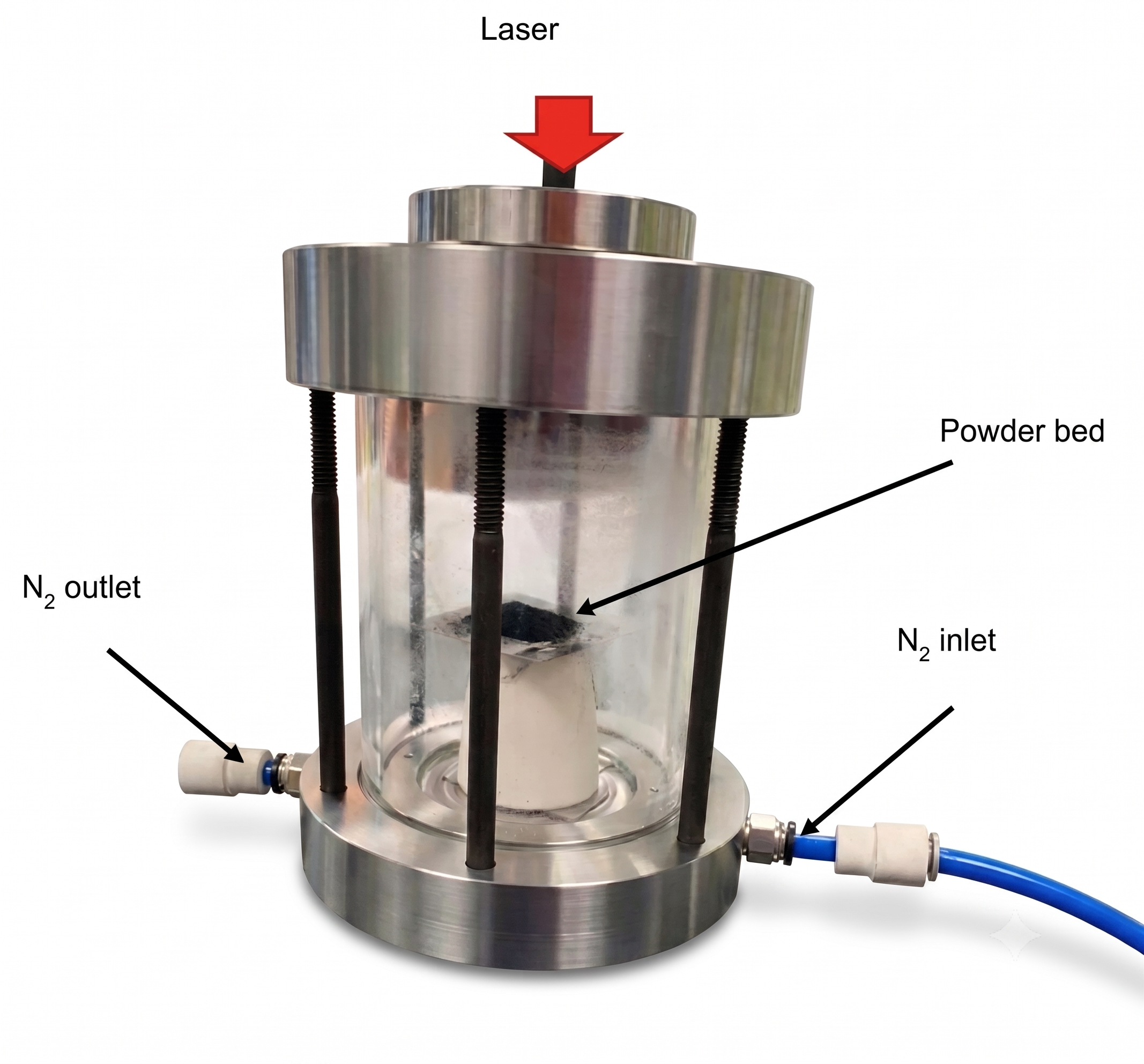
Researchers at Missouri University of Science and Technology have developed the first demonstrated use of selective laser melting (SLM) for battery materials. Unlike selective laser sintering, SLM fully melts electrode particles into a unified structure with high packing density and minimal porosity. Preliminary experiments used lithium iron phosphate with carbon black, processed in a nitrogen-purged chamber. SEM analysis confirmed a higher packing density than that of conventional cast electrodes, and the electrode was tested in a
half-cell configuration with lithium foil and a standard LiPF6 electrolyte.
Value Proposition
SLM electrodes are entirely binder-free. Higher packing density directly improves energy density at the electrode level. The process produces high-resolution electrode structures with more uniform particle distribution and no random porosity.
Development Stage
Demonstrated in the lab.
Intellectual Property
Provisional Patent Application Status: Filed
Inventors
Jonghyun Park, PhD and Tazdik Patwary Plateau, PhD
Follow Technology Transfer and Economic Development