
Case Number: 25MST016
Manager: Robert Prosak
Director, IP & Licensing
S&T Technology Transfer & Economic Development
robert.prosak@mst.edu
PDF Download: Smart multi-magnetron microwave system for advanced materials and composite processing Marketing Slick
Publication: Smart multi-magnetron microwave system for advanced materials and composite processing Publication
Opportunity
Seeking a licensing and development partner to advance this technology from lab scale validation toward field trials and commercial deployment.
Problem Statement
Autoclave curing is the standard method for manufacturing advanced composite parts, but it requires long cure cycles and high processing costs. Microwave curing has been explored as a faster alternative, but conventional single magnetron systems direct energy in only one direction, creating hotspots and uneven heating. These systems also penetrate only about two millimeters into the material, limiting their use on thicker composite sections. A microwave curing system is needed to heat composite parts evenly at any thickness while reducing cost and cycle time.
Solution
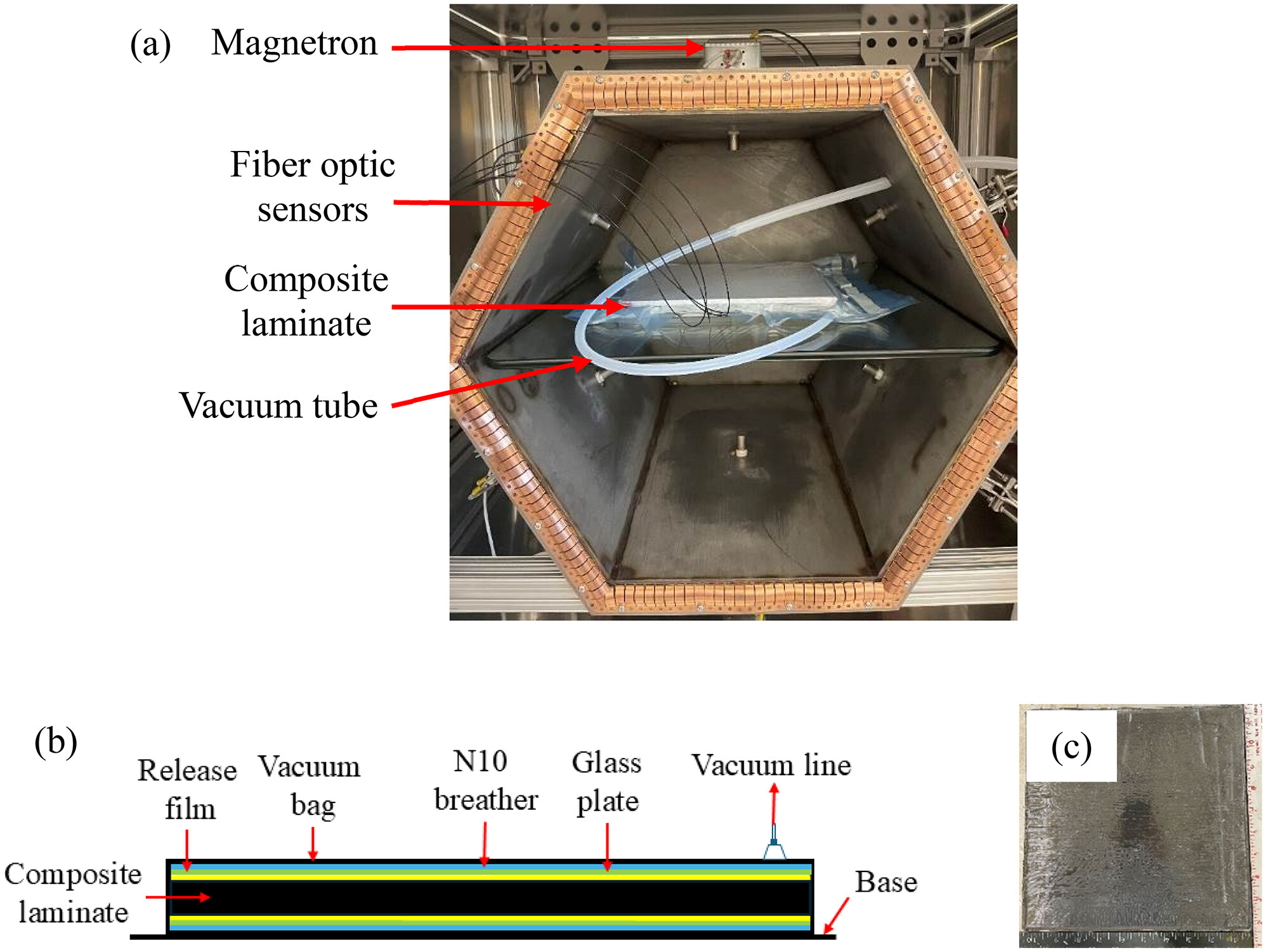
Researchers at Missouri University of Science and Technology have developed a smart multi-magnetron microwave curing system for composite manufacturing. Six magnetrons surround the part in a hexagonal cavity, one on each face, rather than relying on a single magnetron. This spreads microwave energy far more evenly and reduces temperature gradients across the part. Fiber optic sensors monitor temperature at multiple points inside the cavity in real time. A control algorithm uses that data to adjust magnetron power on the fly and keep the cure on track. A vacuum port pulls void content out of the part during cure, improving part quality and strengthening the overall process.
Value Proposition
In testing on a carbon epoxy composite panel, the system cut cure time by two hours compared with autoclave curing. Parts cured with the system also outperformed autoclave-cured parts mechanically. Tensile strength was 7.5 percent higher, Young’s modulus was 11.6 percent higher, and elongation at break was 3.4 percent higher. The system works on both thermoset and thermoplastic matrix composites, can heat parts to 400 degrees Celsius, and offers a safer, faster alternative to autoclave curing.
Development Stage
Validated in the lab. A working prototype has been built and used to manufacture composite panels, which were mechanically tested and compared directly against autoclave cured panels.
Intellectual Property
Provisional Patent Application Filed
Inventors
K Chandrashekhara, PhD, Kristen Donnell, PhD, Nayan Pundhir, PhD and Winky Luo, PhD student
Follow Technology Transfer and Economic Development