
Case Number: 26MST048
Manager: Robert Prosak
Director, IP & Licensing
S&T Technology Transfer & Economic Development
robert.prosak@mst.edu
PDF Download: Solar-Aware Flight Planning and Energy Harvesting for Sustainable Urban Air Mobility PDF
Publication: Solar-Aware Flight Planning and Energy Harvesting for Sustainable Urban Air Mobility Publication
Opportunity
Seeking a licensing and development partner to integrate this framework into UAM flight operations and advance toward testing with a solar-panel prototype for future commercial deployment.
Problem Statement
Urban Air Mobility vehicles spend most of their energy in flight, and charging downtime is a real bottleneck for operators. Electric propulsion does not guarantee a clean footprint either, since grid electricity in many regions still comes from fossil fuels. Rapid charging cycles also place real stress on urban power infrastructure. Solar panels mounted on the aircraft can offset some of
that draw, but only if the flight path passes through good sunlight. Current flight planning treats route selection and solar energy harvesting as separate problems, choosing routes for distance alone without regard for available sunlight. Flight planning needs to capture solar energy without sacrificing route efficiency.
Solution
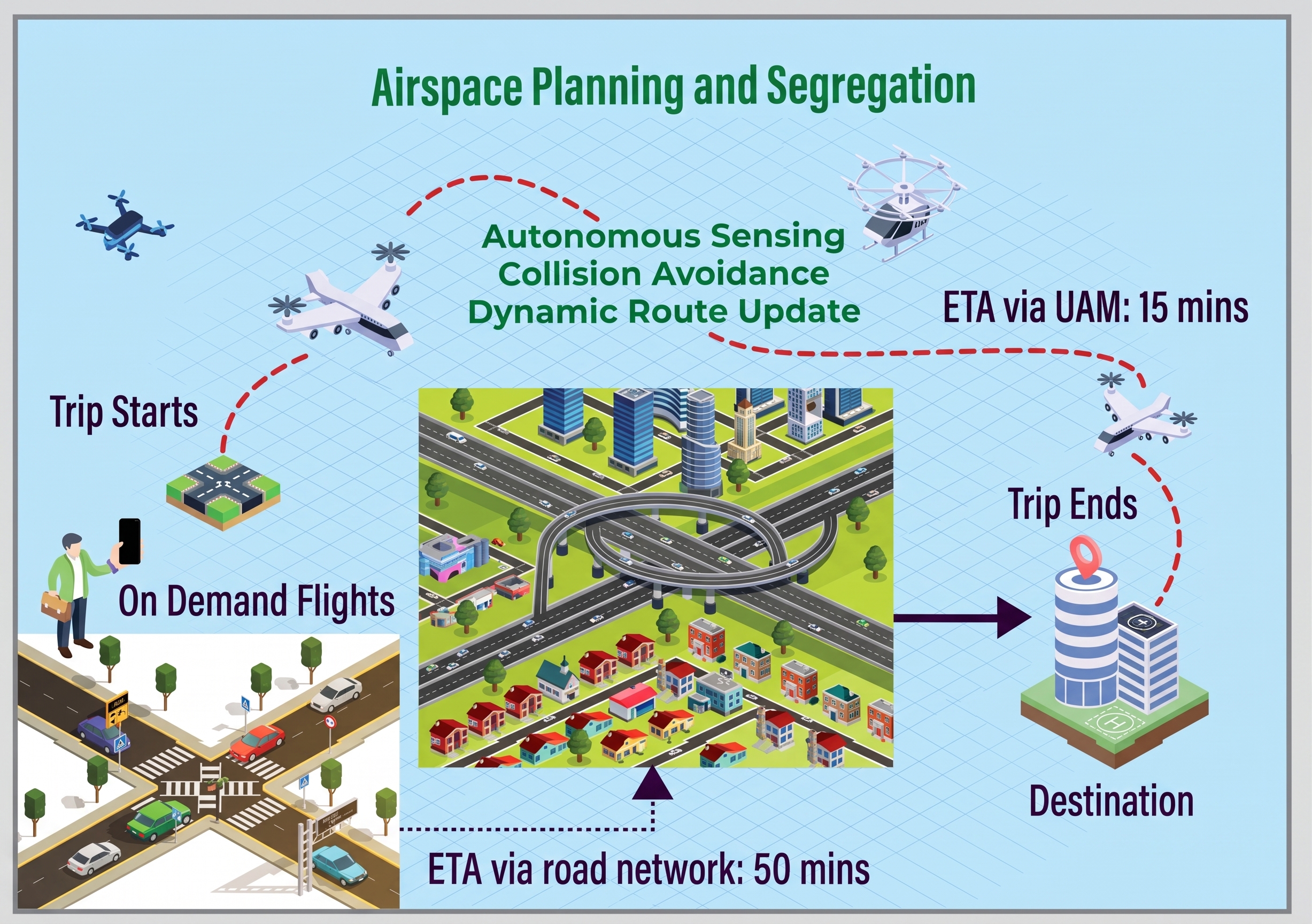
Researchers at Missouri University of Science and Technology have developed a solar-aware flight planning framework for Urban Air Mobility vehicles to address the challenge of capturing solar energy while staying close to the destination. The framework divides the operational airspace into sectors and scores each one with a new Phototropic Index that weighs solar exposure against distance to the
destination. A shortest path algorithm then routes the aircraft toward well-lit sectors without straying far off course. Once a path is chosen, a convex optimization step decides how long the vehicle should spend in each sector to capture the most solar energy within its total flight time budget. The framework runs in a static mode for planned routes and a dynamic mode that replans in real time as sunlight or traffic conditions change. Testing against baseline routing methods on real-world solar irradiance data showed average gains of 8.81% in static conditions and 10.64% in dynamic conditions for total solar exposure, quantified using Global Horizontal
Irradiance (GHI). Under the study’s specified simulation assumptions and conditions, this improvement corresponds to approximately 21.77 kWh of additional energy and an estimated reduction in charging time of approximately three hours using a standard charger (Level 2) or 26 minutes using a fast charger (Level 3)..
Value Proposition
This software-based framework, not new hardware, plugs into flight planning systems already guiding UAM operations. It scales from small airspaces to larger ones without losing solar performance. The dynamic mode keeps performance steady when traffic or sunlight conditions shift mid-flight. Less time charging on the ground means more flights per day and lower reliance on ground-based charging infrastructure.
Development Stage
Framework validated through laboratory-based simulations.
Intellectual Property
Provisional Patent Application Filed
Inventors
Anurag Satpathy, PhD, Debjyoti Sengupta, PhD Candidate, and Sajal K. Das, PhD.
Follow Technology Transfer and Economic Development