
Case Number: 24MST001
Manager: Robert Prosak
Director, IP & Licensing
S&T Technology Transfer & Economic Development
robert.prosak@mst.edu
PDF Download: Structural Batteries via Selective Laser Carbonization Technique Marketing Slick
Publication: Coming Soon
Opportunity
Seeking a licensing and development partner to scale into manufacturing.
Problem Statement
Today’s batteries and structural components are designed separately. This adds weight, bulk, and complexity to drones, electric vehicles, and portable electronics. Existing structural battery approaches rely on carbon fiber reinforced polymer composites. The problem is that the polymer needed for mechanical strength blocks the electrical conductivity required for battery function. Nobody has found a clean and scalable way to have both in the same material without sacrificing one for the other.
Solution
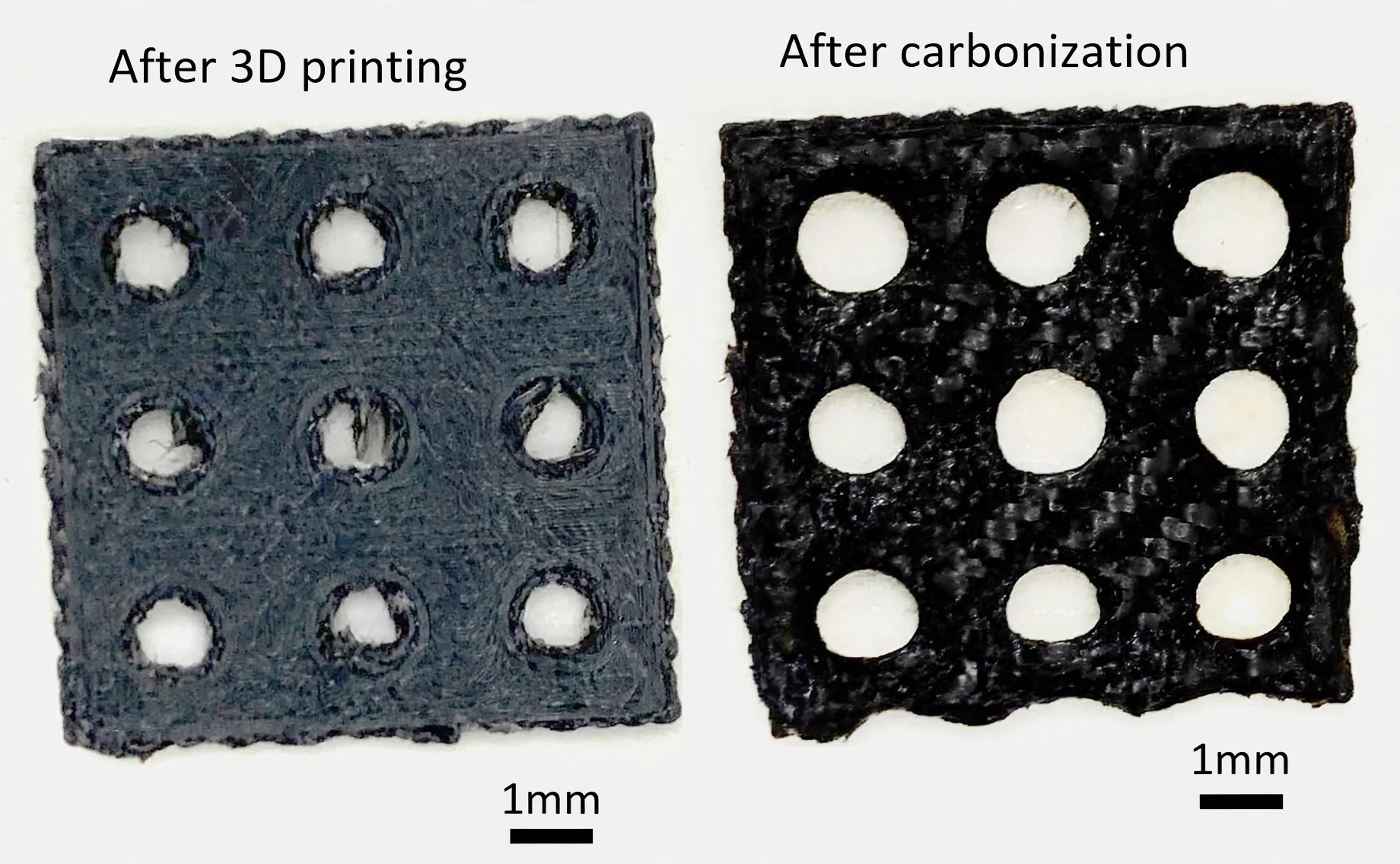
Researchers at Missouri University of Science and Technology have developed a structural battery using standard carbon fiber reinforced polymer filament and a selective laser carbonization process. A conventional FDM 3D printer builds the structure, and a fiber laser then carbonizes only the regions that need to conduct electricity, turning those zones into functional anode material while the surrounding composite retains its mechanical strength. Cathode material is inserted into the pre-designed cavities, and the battery is assembled using either solid state or liquid electrolytes. The result is a single structure that simultaneously bears load and stores energy.
Value Proposition
This approach works with commercially available materials and standard manufacturing equipment, making it accessible and scalable without exotic processes. The three-dimensional interdigitated electrode design shortens lithium ion diffusion paths, improves electrode contact area, and enhances both battery performance and structural properties like shear and torsional strength. Unlike laminate designs, this architecture scales in all three dimensions without redundant current collector layers.
Development Stage
Validated in the lab. Preliminary carbonization and conductivity testing complete.
Intellectual Property
Provisional Patent Application Status: Filed
Inventors
Jonghyun Park, Tazdik Patwary Plateau and Jacob Sutton
Follow Technology Transfer and Economic Development