
Case Number: 26MST026
Manager: Robert Prosak
Licensing Associate, Business Development
S&T Technology Transfer & Economic Development
robert.prosak@mst.edu
PDF Download: Sub-Millimeter Resolution Distributed Fiber Bragg Grating Sensor Architecture Marketing Slick
Publication: Sub-Millimeter Resolution Distributed Fiber Bragg Grating Sensor Architecture Publication
Opportunity
Seeking a licensing and development partner to advance this fiber-sensor architecture from prototype to commercial scale.
Problem Statement
Manufacturers and researchers need a way to track steep temperature changes over very short distances in tight spaces, such as casting molds and additive manufacturing systems. Today, distributed fiber sensors rely on Raman, Brillouin, or Rayleigh backscattering, paired with highly expensive optical frequency domain reflectometry equipment. Raman- and Brillouin-based distributed sensors generally lack sub-millimeter spatial resolution, while Rayleigh-OFDR systems can reach this regime but require costly instrumentation and complex signal processing. Traditional fiber Bragg grating arrays introduce dark zones between gratings, creating blind spots in the data. There is a real need for a distributed sensor that reads finer detail without the prohibitive price tag.
Solution
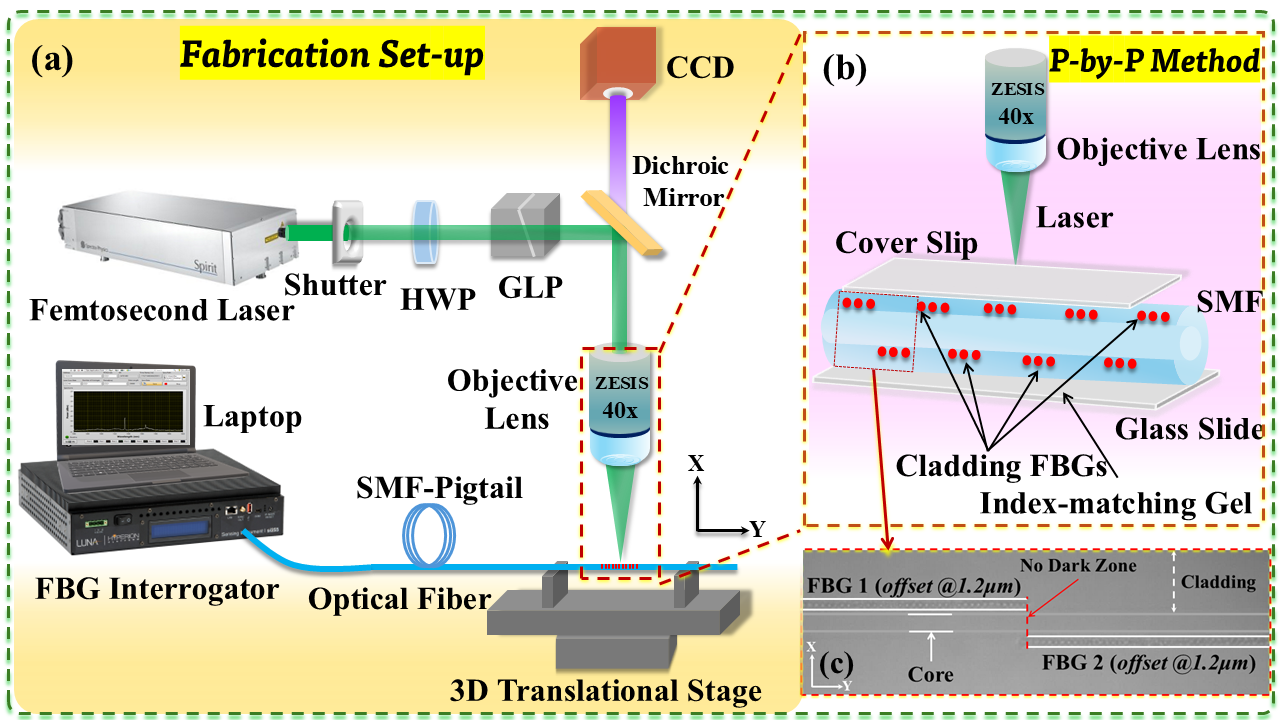
Researchers at Missouri University of Science and Technology have developed a staggered contiguous cladding fiber Bragg grating array for fully distributed optical sensing. The gratings sit in the cladding just outside the fiber core, which captures a strong signal without damaging the core. A working prototype with 13 gratings over a sensing length of 1.04 centimeters achieved a spatial resolution of 800 microns using a standard spectral interrogator rather than costly OFDR hardware. Testing showed a linear hysteresis-free temperature response up to 710 degrees Celsius with a sensitivity of 15.17 picometers per degree. The contiguous grating arrangement eliminates the dark zones found in conventional FBG arrays, while the staggered configuration suppresses spectral interference between adjacent gratings.
Value Proposition
This sensor design runs on a spectral interrogator priced at a fraction of the cost of the highly expensive OFDR systems the field relies on today, making it drastically more affordable. The gratings are inscribed with femtosecond lasers on standard telecom fiber, so no exotic materials are needed. That combination of fine resolution, low cost, and heat tolerance fits directly into metal casting, where tracking solidification at the liquid-to-solid interface demands the detail that standard sensors cannot capture. The same architecture applies to additive manufacturing and microreactor systems, where space is tight, and conventional sensors cannot be embedded. Multiple segments can also be linked together to extend the sensing range while holding onto the same fine resolution.
Development Stage
Validated in the lab.
Intellectual Property
Provisional Patent Application Filed
Inventors
Jie Huang,Chen Zhu, Koustav Dey, Rex E. Gerald II, Laura Bartlett, Ogbole Collins Inalegwu and Ruimin Jie
Follow Technology Transfer and Economic Development