
Case Number: 26MST029
Manager: Robert Prosak
Director, IP & Licensing
S&T Technology Transfer & Economic Development
robert.prosak@mst.edu
PDF Download: Tapped-Inductor Buck-Based Dual Active Bridge Power Electronic Converter Marketing Slick
Publication: Coming Soon
Opportunity
Seeking a licensing and development partner to advance this converter design into hardware prototyping and commercialization.
Problem Statement
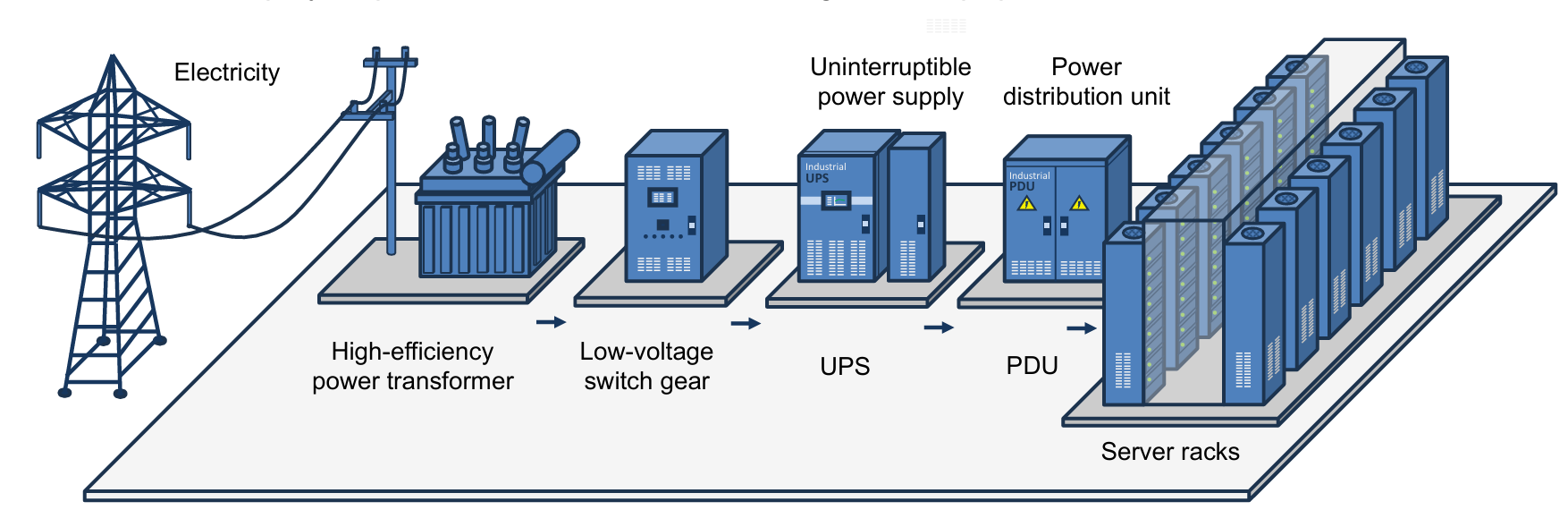
Isolated DC-to-DC converters that step down high voltages typically use the dual-active-bridge topology. Achieving a high step-down ratio requires a high transformer turns ratio, which increases parasitic effects, makes the transformer harder to design, and lowers overall efficiency. This trade-off is becoming more critical as data centers and AI hardware move toward 800 V architectures that require
efficient conversion to 48 V. There is a need for a converter that achieves a high conversion ratio without pushing transformer design beyond its practical limits.
Solution
Researchers at Missouri University of Science and Technology developed a new converter topology for isolated step-down power conversion. The design combines a tapped-inductor buck stage with a dual-active-bridge converter into a single-stage circuit. Switches are shared between the step-down and inversion functions, so the transformer carries only part of the total conversion ratio rather than all of it. The primary bridge generates its AC voltage, so its average remains zero even when the duty cycle deviates from the ideal 50 percent. This keeps the transformer from drifting toward saturation, a risk in similar converter designs. A 1000V-to-48V version of the converter was simulated and delivered 1500 W of output power, matching the converter’s theoretical model.
Value Proposition
This converter offers a higher step-down ratio than existing half-bridge dual-active-bridge designs in a single stage. Combining buck and isolation functions into one circuit with shared switches reduces the number of components compared with running a separate buck converter ahead of a dual-active bridge. That points to lower cost and higher efficiency for high-ratio isolated power conversion, a strong fit for 800 V data center and AI server power architectures.
Development Stage
Validated through circuit simulation.
Intellectual Property
Provisional Patent Application Filed
Inventors
Amirhossein Habibi and Mehdi Ferdowsi
Follow Technology Transfer and Economic Development