
Case Number: 26MST005
Manager: Robert Prosak
Director, IP & Licensing
S&T Technology Transfer & Economic Development
robert.prosak@mst.edu
PDF Download: Thermal testing device of materials under controlled electrical bias conditions Marketing Slick
Publication: Ali Sarikhani, Gregory E. Hilmas, David W. Lipke, Douglas E. Wolfe, Stefano Curtarolo, Shen J. Dillon, Ahmad Mirzael, Yew San Hor, William G. Fahrenholtz, “Thermal Rectification in an AI/Mo/ n-Sl Schottky Heterostructure”.
Opportunity
Seeking a licensing and development partner to advance this fiber-sensor architecture from prototype to commercial scale.
Problem Statement
Manufacturers and researchers need a way to track steep temperature changes over very short distances in tight spaces, such as casting molds and additive manufacturing systems. Today, distributed fiber sensors rely on Raman, Brillouin, or Rayleigh backscattering, paired with highly expensive optical frequency domain reflectometry equipment. Raman- and Brillouin-based distributed sensors generally lack sub-millimeter spatial resolution, while Rayleigh-OFDR systems can reach this regime but require costly instrumentation and complex signal processing. Traditional fiber Bragg grating arrays introduce dark zones between gratings, creating blind spots in the data. There is a real need for a distributed sensor that reads finer detail without the prohibitive price tag.
Solution
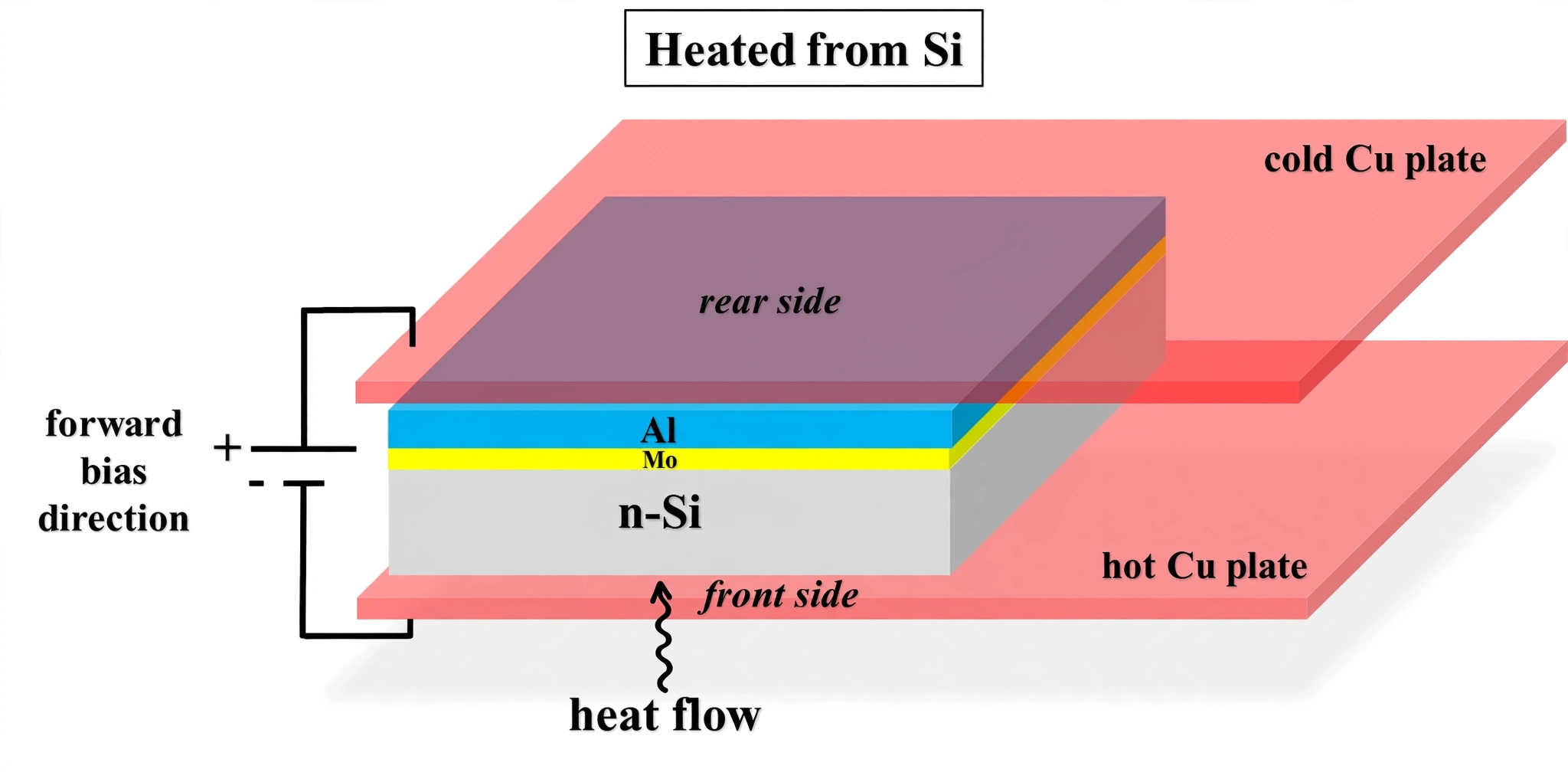
Researchers at Missouri University of Science and Technology have developed a benchtop device that combines thermal-property testing with controlled electrical bias in a single setup. A specimen sits between conductive plates. The device applies controlled heat, measures temperature differences, and adds electrical bias and voltage-measurement capabilities within a single workflow. This lets users study how heat transport changes under an electric field. In one setup, it measures thermal conductivity, thermal diffusivity, and bias-sensitive electrothermal response. The result is bias-dependent thermal testing that no longer depends on fragmented workflows or custom academic rigs.
Value Proposition
The device closes a real measurement gap by bringing controlled-bias electrothermal testing to the benchtop. Its architecture is relatively simple, which supports manufacturability and OEM integration. It fits naturally as a licensed module, a thermal-analysis accessory, or a co-developed product with an established instrument vendor. It is well suited to electrically active materials such as
thermoelectrics, semiconductors, batteries, and thermal-management materials, and it meets growing demand for better tools in electronics thermal management.
Development Stage
Early benchtop prototype with proof-of concept experimental data.
Intellectual Property
Provisional Patent Application Filed
Inventors
Ali Sarikhani, William G. Fahrenholtz, Gregory E. Hilmas, Yew San Hor and Stefano Curtarolo
Follow Technology Transfer and Economic Development