
Case Number: 26MST017
Manager: Robert Prosak
Director, IP & Licensing
S&T Technology Transfer & Economic Development
robert.prosak@mst.edu
PDF Download: Threaded Modular Chemical Sensing Insert Tips Marketing Slick
Publication: Coming Soon
Opportunity
Seeking a licensing and development partner to bring this sensor platform to market.
Problem Statement
Resonant electromagnetic sensors are highly sensitive to whatever sits at their tip. But in most designs, the sensing material is built directly into the probe. Once installed, it cannot be swapped without rebuilding the entire sensor. Contamination is hard to remove, and a failed test can permanently damage the device. This slows the search for new sensing materials and limits how quickly a sensor can be adapted to a new target. Water vapor adds a further problem. It interacts strongly with most sensing materials and often
overwhelms the signal from the analyte that a user is actually trying to detect.
Solution
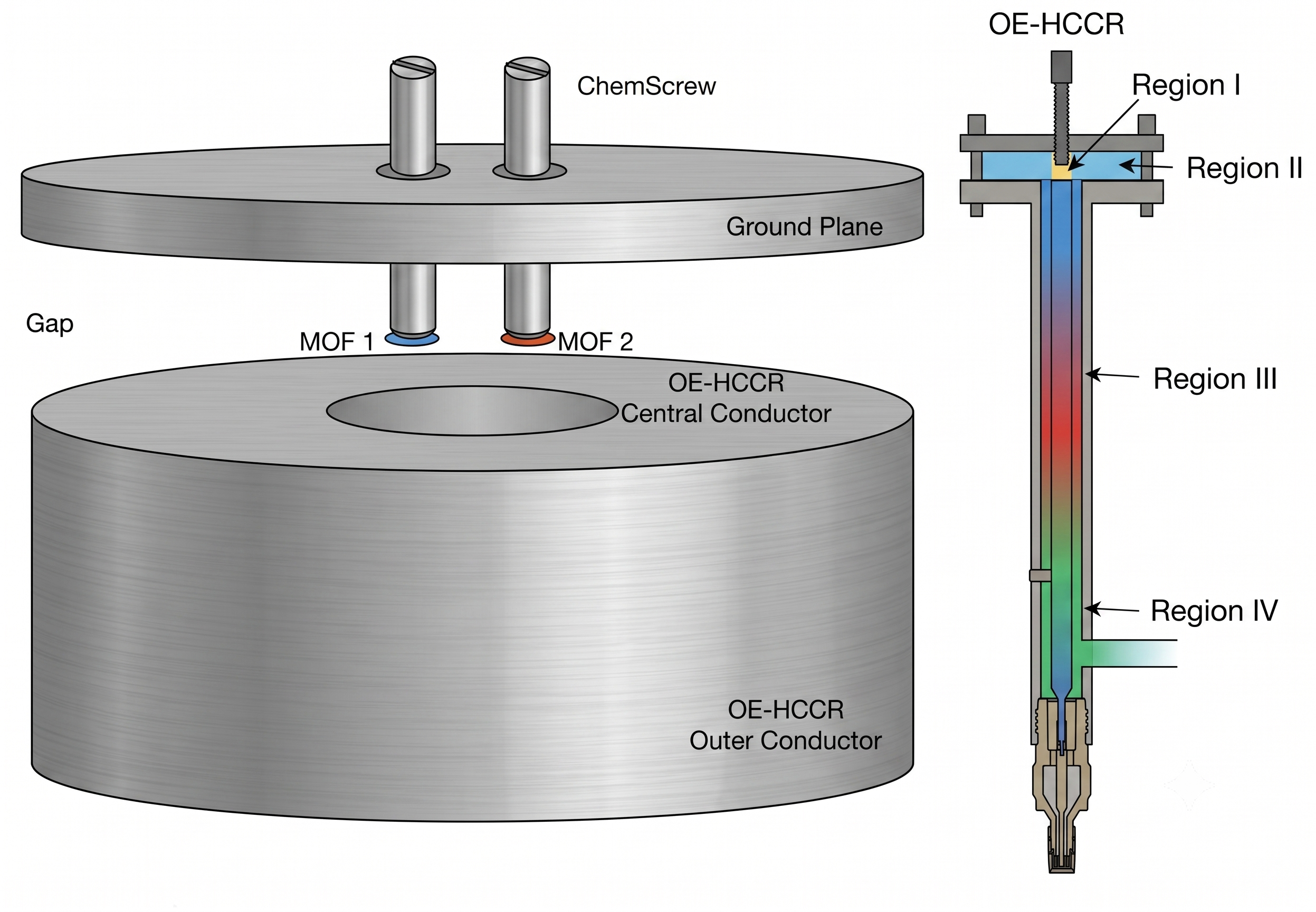
Researchers at Missouri University of Science and Technology have developed interchangeable threaded tips for open-ended hollow coaxial cable resonators. Each tip screws into the resonator and can be swapped in seconds without touching the rest of the device. One tip design uses a membrane to separate a target molecule from water, letting the target pass through in milliseconds while water takes several minutes to travel the same distance. This creates a clean window for reading before humidity interferes. The same conductive layer that defines the sensing region also works as a heater, so a tip can clean itself and reset for another reading instead
of being discarded after one use. Multiple tips can also run in the same probe at once. Each can carry a different sorptive material, such as a different metal organic framework, so the combined response builds a richer chemical fingerprint. This helps the probe distinguish analytes that would look alike to a single tip. Other tip designs extend the same resonator beyond gas sensing. Some measure pressure or temperature. Others monitor battery electrode interfaces or track catalyst activity in real time. Some carry small fluid channels for mixing and reaction studies.
Value Proposition
This architecture turns one sensor body into a versatile platform. Because the functional material lives in the tip, the resonator itself never has to be rebuilt to take on a new job. The water-separating tip addresses one of the most common failure points in chemical sensing, since humidity often drowns out the signal a user actually wants. A heater built into the same conductive layer lets a tip reset for another reading instead of being thrown away after one use. Running several tips in parallel lets one probe sense multiple parameters at once and sharpen its ability to tell apart similar analytes without adding separate sensors. A single resonator can take on gas detection duty one day and battery diagnostics the next simply by changing the tip.
Development Stage
A prototype tip coated with a metal-organic framework has been built and tested in the lab.
Intellectual Property
Provisional Patent Application Filed
Inventors
Sara McDaniel, Ryan O’Malley, Rex E. Gerald II , Chen Zhu, Bohong Zhang, Koustav Dey, Jie Huang, Michael Davis
Follow Technology Transfer and Economic Development