
Case Number: 25MST019
Manager: Robert Prosak
Director, IP & Licensing
S&T Technology Transfer & Economic Development
robert.prosak@mst.edu
PDF Download: Ultrasensitive MUC1 Detection Using a DNA Origami–Enabled Electrochemical Biosensor Marketing Slick
Publication: Ultrasensitive MUC1 Detection Using a DNA Origami–Enabled Electrochemical Biosensor Publication
Opportunity
Seeking a licensing and development partner to advance this biosensor toward clinical use and commercialization.
Problem Statement
Breast cancer is the most commonly diagnosed cancer among women and remains one of the leading causes of cancer-related mortality worldwide. MUC 1 is a clinically relevant cancer-associated protein that is frequently overexpressed in breast and other epithelial cancers, making it a promising biomarker for cancer detection and monitoring. Current diagnostic approaches, including mammography and MRI, have improved breast cancer screening and diagnosis but may be limited by false positives, cost, accessibility, and the need for specialized equipment. A sensitive and minimally invasive method for detecting low concentrations of MUC 1 in biofluids could enable the development of next-generation cancer diagnostic and monitoring technologies.
Solution
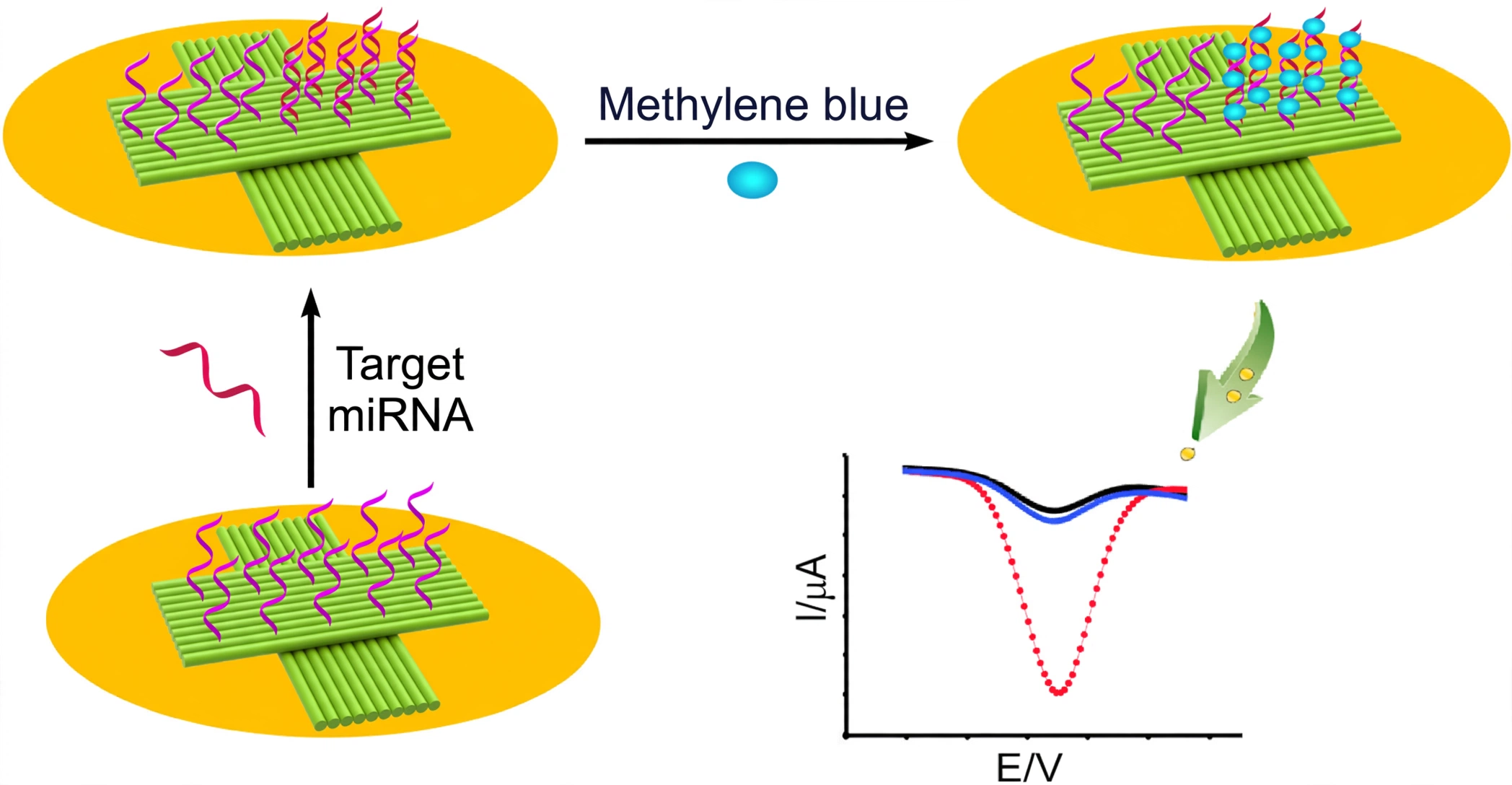
Researchers at Missouri University of Science and Technology developed an electrochemical biosensor that combines three-dimensional DNA origami with graphene quantum dots and gold nanoparticles. The DNA origami scaffold organizes the sensing components with nanoscale precision, while the nanoparticles enhance electrochemical signal transduction. A MUC 1-responsive hairpin probe changes conformation upon target binding, producing a measurable change in current that enables highly sensitive detection.
Value Proposition
This ultrasensitive, electrochemical biosensor detects MUC 1 at femtomolar concentrations across a broad analytical range. Highly selective, it achieves 98.0%–100.6% recovery in human serum. Because its programmable DNA origami architecture readily accommodates additional biomarkers, the platform paves the way for compact, point-of-care testing devices and serves as a versatile foundation for next-generation cancer diagnostics.
Development Stage
Validated in the lab and tested in human serum samples spiked with MUC 1
Intellectual Property
Provisional Patent Application Filed
Inventors
Risheng Wang, Wenyan Liu and Krishna Thapa
Follow Technology Transfer and Economic Development