
Case Number: 20MST025
Manager: Robert Prosak
Director, IP & Licensing
S&T Technology Transfer & Economic Development
robert.prosak@mst.edu
PDF Download: Ultrathin film coating and element doping for lithiumion battery electrodes Marketing Slick
Publication: Ultrathin film coating and element doping for lithiumion battery electrodes Publication
Opportunity
Seeking a licensing and development partner to scale into commercial metals recovery operations.
Problem Statement
NMC 811 is a next-generation cathode material for electric vehicle batteries. It offers high capacity, high voltage and low cost. But it fades quickly. Its surface reacts with the electrolyte, and its structure breaks down when it is charged to high voltage. To protect the cell, manufacturers limit the upper voltage, which lowers energy density. Alumina coatings give a stable surface but sacrifice capacity. Zirconium doping mainly improves structural stability. There is a need for one approach that delivers both.
Solution
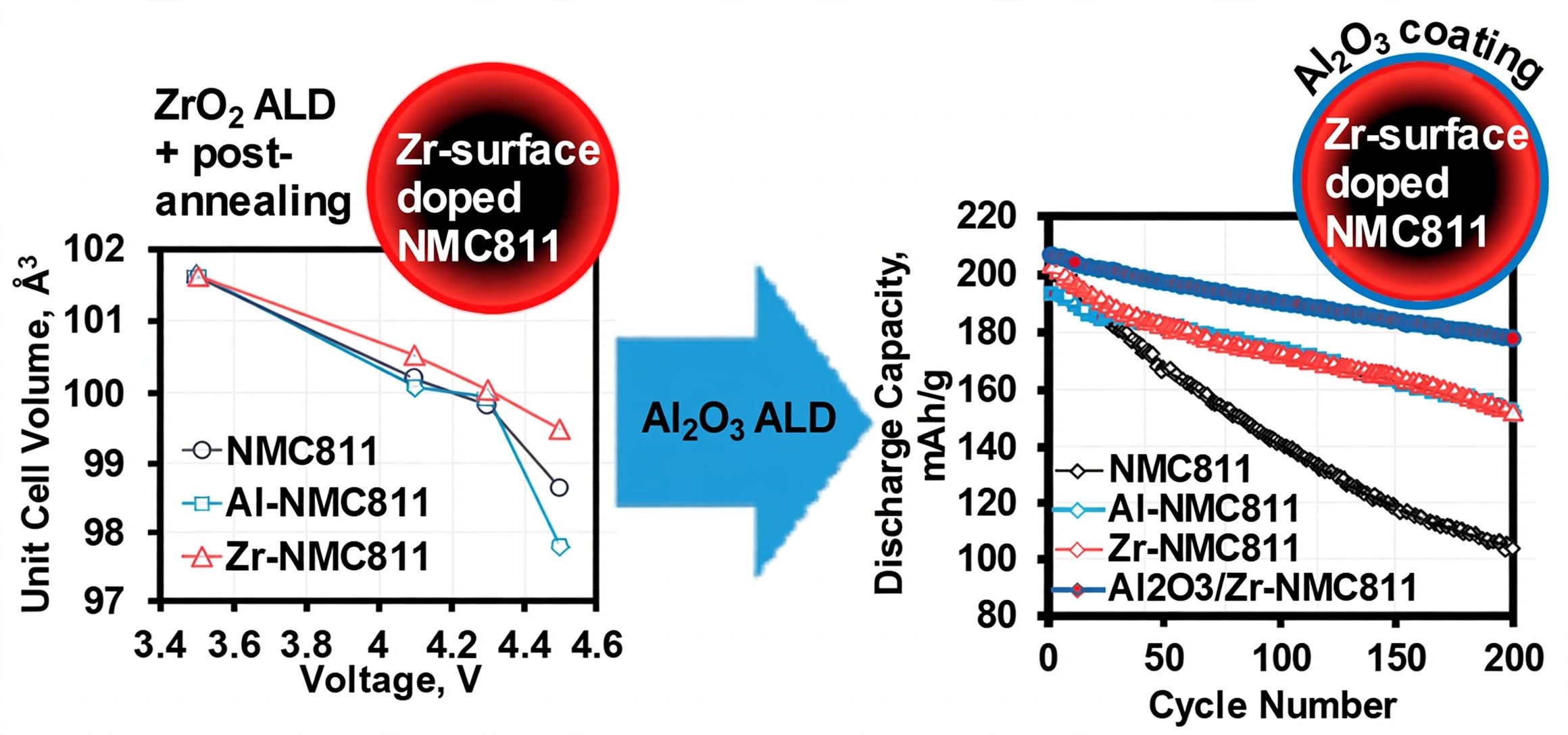
Researchers at Missouri University of Science and Technology developed a two step process to treat NMC811 particles. Atomic layer deposition (ALD) first places a thin zirconium oxide film on the particles. Annealing then moves zirconium into the surface of the material as a dopant. A second ALD step adds four cycles of alumina, about 0.5 nm thick. Zirconium supports the structure and eases the lattice collapse that happens at high voltage. Alumina gives a stable surface. The two together solve problems that neither can solve alone.
Value Proposition
After 200 cycles between 2.5 and 4.5 V at 0.5C, half cells with the treated cathode kept 85.9% of an initial 208 mAh/g. Pristine NMC811 kept 51.1%. Zirconium alone kept 75.3% and alumina alone kept 79.2%. The alumina layer did not raise the internal resistance of the cell. The alumina step is easy to run and relatively cheap. The same strategy can be applied to other films to help lithium ion batteries reach higher voltage, higher energy density and longer life.
Development Stage
Validated in the lab in lithium ion coin half cells.
Intellectual Property
US Patent 12,191,485 B 2
Inventors
Xinhua Liang, PhD and Yan Gao, PhD
Follow Technology Transfer and Economic Development